Quality reporting is an essential revenue cycle task tied closely to reimbursement, but it can cost providers big time, a new study says.
CMS says it collects quality data from hospitals paid under the IPPS with the goal of driving quality improvement through measurement and transparency to help consumers make more informed decisions, however gathering this information for CMS is proving time consuming and expensive for hospitals.
The new study published in JAMA set out to evaluate externally reported inpatient quality metrics for adult patients and estimate the cost of data collection and reporting, independent of quality-improvement efforts, and the conclusion was staggering.
The retrospective study at Johns Hopkins Hospital found that in 2018, quality reporting for 162 metrics cost the system over $5 million and took 108,478 personnel hours to complete.
In fact, according to JAMA, the hospital spent an estimated $5,038,218.28 in personnel costs plus an additional $602,730.66 in vendor fees that year.
Of the quality metrics studied, a total of 162 unique metrics were identified, of which 96 (59.3%) were claims-based, 107 (66.0%) were outcome metrics, and 101 (62.3%) were related to patient safety, according to the study.
The study also found that claims-based (96 metrics; $37,553.58 per metric per year) and chart-abstracted (26 metrics; $33, 871.30 per metric per year) metrics used the most resources per metric, while electronic metrics consumed far less (4 metrics; $1,901.58 per metric per year).
Johns Hopkins is a large system and the $5 million spent on quality reporting was a small portion of the hospital’s $2 billion in annual expenses that year, but that is not to say these metrics are not costly and time consuming overall.
The authors go on to explain that significant resources are expended exclusively for quality reporting, and some methods of quality assessment are obviously far more expensive than others.
“Claims-based metrics were unexpectedly found to be the most resource intensive of all metric types. Policy makers should consider reducing the number of metrics and shifting to electronic metrics, when possible, to optimize resources spent in the overall pursuit of higher quality,” the study said.
One expert shares five ways CFOs at prominent organizations across the country are maintaining financial stability in 2023.
CEOs say that 2023 is all about embracing the current reality and deciding maybe it’s not as bad as it could be. But now is not the time to ease up on strategy.
While this could be seen as good news, CFOs know they need to stay ahead of the curve and keep preparing for the next big financial hurdle.
“There is no single strategy [to maintaining financial stability]. It is highly multifaceted, and all levers must be pulled,” Swanson said. But there are five trends that Swanson says CFOs are deploying to ensure they remain financially stable:
Workforce optimization
When we talk about labor expenses and managing the workforce, a lot of organizations are looking at how they can think about workforce optimization by employing data and analytics in a more useful way to understand the appropriate complement of staff and workforce that they’d need to deliver care in the appropriate ways and in the most economical fashion.
Reducing the reliance on contract labor is another lever to pull. Some organizations are re-examining their float pool size or perhaps even creating their own internal staffing agency for some of those large systems. Some are considering recruitment retainment and those pipelines for ensuring that talent is coming in.
Some organizations are partnering closely with local nursing schools, in some cases offering tuition assistance or even full tuition assistance to build a pool of candidates to address some of the labor shortages. That strategy will take a few years, but it’s useful. It's also critical to create an environment where everyone works to the top of their license and top of their ability across the organization.
Supply chain management
What we’re seeing on the non-labor side is around more effective supply chain management by building scale and leveraging that to get preferred rates with vendors and in many cases, reducing the amount of variation in suppliers.
Payer negotiations
On the revenue side, negotiating with payers as those opportunities arise and negotiating in a way such that those dollars are focused on where the patient populations will be, versus where they have historically been, is important.
Value-based care models
Some organizations are exploring where to move on as they move more towards a value-based care model. Organizations that had greater value-based care models tended to outperform those that did not during the pandemic.
Reexamining the future of care delivery
Leaders also need to think strategically about what care looks like. What does care delivery in the future look like? And making sure that they are positioning themselves for the future, while managing their day-to-day, but not losing sight of what that future may hold.
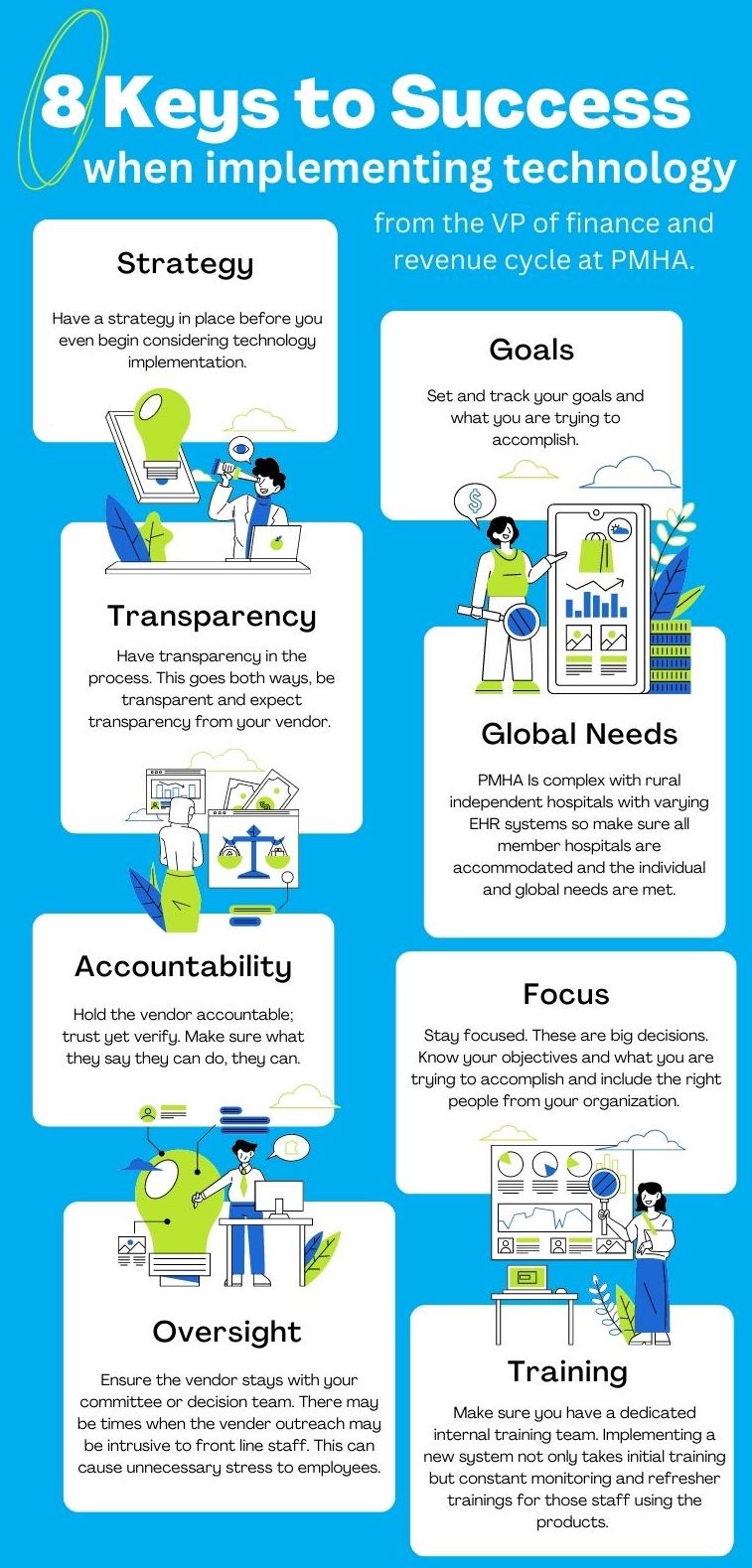
The VP of finance and revenue cycle at PMHA outlines eight keys to success when implementing technology.
When budgets are tight, leaders need to be strategic when investing in technology. Because cost efficiency is so important, revenue cycle leaders need to make sure there is a substantial ROI when considering technology.
Nicole Clawson, VP of finance and revenue cycle at Pennsylvania Mountains Healthcare Alliance (PMHA), feels these same pressures at her health system. And, as a collaborative network of independent community hospitals located primarily in Western and Central Pennsylvania, the system needs to be cognizant of costs while improving operations.
To help ensure financial stability, Clawson says PMHA is in the process of implementing a combination of technology and operational expertise to monitor revenue cycle data flow from beginning to end with four of its member hospitals.
As Clawson and her teams are currently in the throes of technology implementation, she has eight keys to success for other finance and revenue cycle leaders looking to make the most of new technology while keeping costs low.
Nonprofit hospitals are seeing substantial growth in operating profits and cash reserves but at the cost of charity care, a new study says.
It seems not all finance leaders are fighting against poor operating profits.
In fact, according to a new study published by Health Affairs, the mean operating profits for nonprofit hospitals grew from $43 million in 2012 to $58.6 million by 2019, while mean cash reserve balances increased from $133.3 million to $224.3 million.
As developing and executing a strategic path to a financially sustainable future is essential for these leaders, it looks like it’s at the expense of charity care, the study says.
While profits grew from 2012 to 2019, the increase was not associated with the provision of more charity care by nonprofit hospitals. In fact, spending on charity care actually dropped during that time period: from $6.7 million in 2012 to $6.4 million.
The IRS has not stated specific quantitative requirements for the community benefits that nonprofit hospitals must provide, the study said. But, “Our results suggest that linking minimum contributions to charity care with profit increases may be helpful,” the study authors wrote.
With operating profits for nonprofit hospitals growing, the share of community health benefits they provide should also be growing to justify their favorable tax treatment, the study said.
The new study published in Health Affairs is not the first to take aim at nonprofit charity care spending as they are required to provide charity care and other community benefits in exchange for their tax-exempt status.
A Lown Institute hospitals index report said nonprofit hospitals collectively failed to invest nearly $17 billion in their communities in 2021, which included charity care spending.
At the time, the hospital index highlighted Vanderbilt University Medical Center and several other nonprofit, blue-chip providers for enjoying large tax breaks while falling short in making appropriate community health investments.
Vanderbilt University Medical Center responded with the following statement defending its charity care spending:
[For fiscal year 2021], Vanderbilt University Medical Center [VUMC] provided more than $829 million in charity care and other community benefits in service to the citizens of Tennessee. These funds support direct patient care and a range of initiatives that positively impact Tennesseans in other ways through improvements in community health.
The analysis by this organization allows only certain financial measures to be counted while intentionally excluding other beneficial activities traditionally supported by academic medical centers like VUMC that require considerable financial commitment.
In addition to the Lown Institute, a report from the state treasurer's office published last year took aim at North Carolina’s nonprofit hospitals. It found that although the nonprofit hospitals in the state received tax exemptions to provide charity care that were valued at more than $1.8 billion in 2020, most didn't provide enough charity care to equal the amount of those tax breaks.
Instead, "North Carolina's nonprofit hospitals billed the poor at an average rate up to almost three times the national average," the report said.
"Nonprofit hospitals are often more profitable than for-profits in North Carolina," the report said. "All the top 10 most profitable hospitals were nonprofits in fiscal year 2019."
Mergers and acquisitions are on the mind of every CEO and CFO as leaders need to develop a strategic path to a financially sustainable future.
As CFOs and CEOs fight against poor operating margins, reduced reimbursement, and inflated expenses, developing and executing a strategic path to a financially sustainable future is essential. For some, this can mean an acquisition or merger.
Hospitals and health systems of every type are feeling the financial pressure—even nonprofits will continue to grapple with existential questions about their strategy and structure moving forward.
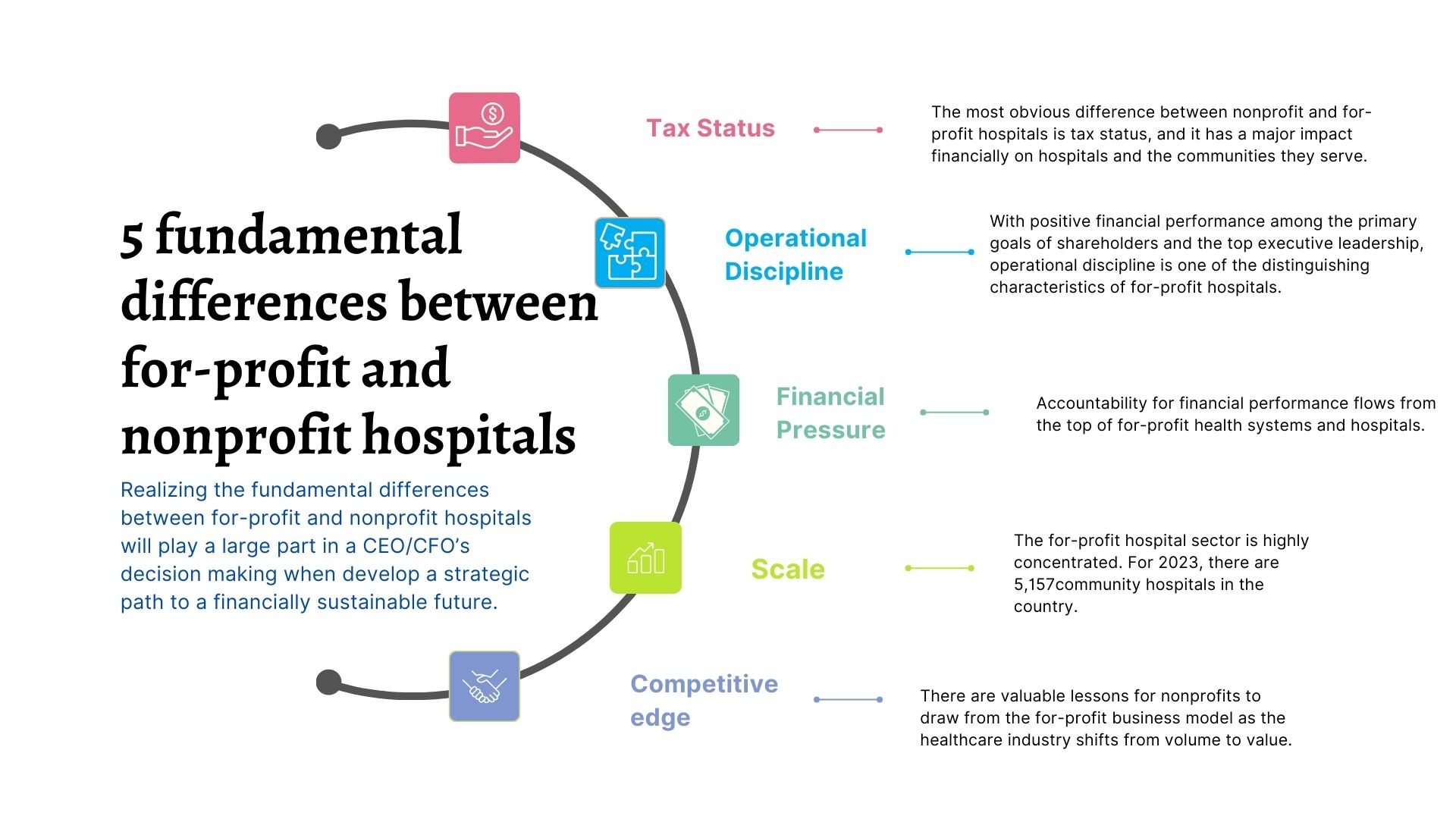
Realizing the fundamental differences between for-profit and nonprofit hospitals will play a large part in a leader’s decision making.
For-profit and nonprofit hospitals are fundamentally similar organizations with subtly different cultural approaches to managing the economics of healthcare. All acute care hospitals serve patients, employ physicians and nurses as their primary personnel, and operate in the same regulatory framework for delivery of clinical services.
There are, however, a few primary differences between for-profit and nonprofit hospitals, which could potentially impact ROI. Read on about these differences, updated from our previous coverage.
Tax Status
The most obvious difference between nonprofit and for-profit hospitals is tax status, and it has a major impact financially on hospitals and the communities they serve.
Hospital payment of local and state taxes is a significant benefit for municipal and state governments, said Gary D. Willis, a former for-profit health system CFO said. The taxes that for-profit hospitals pay support "local schools, development of roads, recruitment of business and industry, and other needed services," he said.
The financial burden of paying taxes influences corporate culture—emphasizing cost consciousness and operational discipline. For example, for-profit hospitals generally have to be more cost-efficient because of the financial hurdles they have to clear.
Operational Discipline
With positive financial performance among the primary goals of shareholders and the top executive leadership, operational discipline is one of the distinguishing characteristics of for-profit hospitals, said Neville Zar, the former senior vice president of revenue operations at Steward Health Care System, a for-profit that includes 3,500 physicians and 18 hospital campuses in four states.
When Zar was at the system, a revenue-cycle dashboard report was circulated at Steward every Monday morning at 7 a.m., including point-of-service cash collections, patient coverage eligibility for government programs such as Medicaid, and productivity metrics.
A high level of accountability fuels operational discipline at for-profits, Zar said.
Financial pressure
Accountability for financial performance flows from the top of for-profit health systems and hospitals, said Dick Escue, senior vice president and CIO at the Hawaii Medical Service Association in Honolulu.
Escue worked for many years at a rehabilitation services organization that for-profit Kindred Healthcare of Louisville, Kentucky, acquired in 2011. "We were a publicly traded company. At a high level, quarterly, our CEO and CFO were going to New York to report to analysts. You never want to go there and disappoint. … You're not going to keep your job as the CEO or CFO of a publicly traded company if you produce results that disappoint."
Finance team members at for-profits must be willing to push themselves to meet performance goals, Zar said.
For-profit hospitals also routinely utilize monetary incentives in the compensation packages of the C-Suite leadership, said Brian B. Sanderson, managing principal of healthcare services at Crowe.
"The compensation structures in the for-profits tend to be much more incentive-based than compensation at not-for-profits," he said. "Senior executive compensation is tied to similar elements as found in other for-profit environments, including stock price and margin on operations."
In contrast to offering generous incentives that reward robust financial performance, for-profits do not hesitate to cut costs in lean times, Escue says.
"The rigor around spending, whether it's capital spending, operating spending, or payroll, is more intense at for-profits. The things that got cut when I worked in the back office of a for-profit were overhead. There was constant pressure to reduce overhead," he says. "Contractors and consultants are let go, at least temporarily. Hiring is frozen, with budgeted openings going unfilled. Any other budgeted, but not committed, spending is frozen."
Scale
The for-profit hospital sector is highly concentrated. For 2023, there are 5,157 community hospitals in the country, according to the American Hospital Association. Nongovernmental not-for-profit hospitals account for the largest number of facilities at 2,978. There are 1,235 for-profit hospitals, and 944 state and local government hospitals.
On the other hand, the country's for-profit hospital trade association, the Federation of American Hospitals, represents 1,000 tax-paying community hospitals and health systems throughout the U.S., accounting for nearly 20% of U.S. hospitals.
Scale generates several operational benefits at for-profit hospitals.
"Scale is critically important," said Julie Soekoro, former CFO of a Community Health Systems (CHS)-owned hospital. And one benefit of being CHS-owned? The access to resources and expertise, Soekoro said at the time.
Best practices are shared and standardized across all CHS hospitals. "Best practices can have a direct impact on value," Soekoro says. "The infrastructure is there. For-profits are well-positioned for the consolidated healthcare market of the future… You can add a lot of individual hospitals without having to add expertise at the corporate office."
The High Reliability and Safety program at CHS is an example of how standardizing best practices across the health system's hospitals has generated significant performance gains, she says.
Scale also plays a crucial role in one of the most significant advantages of for-profit hospitals relative to their nonprofit counterparts: access to capital.
Ready access to capital gives for-profits the ability to move faster than their nonprofit counterparts, Sanderson says. "They're finding that their access to capital is a linchpin for them. … When a for-profit has better access to capital, it can make decisions rapidly and make investments rapidly. Many not-for-profits don't have that luxury."
Competitive edge
There are valuable lessons for nonprofits to draw from the for-profit business model as the healthcare industry shifts from volume to value.
When healthcare providers negotiate managed care contracts, for-profits have a bargaining advantage over nonprofits, Doran says. "In managed care contracts, for profits look for leverage and nonprofits look for partnership opportunities. The appetite for aggressive negotiations is much more palatable among for-profits."
UHC is pulling back on its controversial prior authorization mandate.
UHC was set to require added prior authorizations for nearly half (47%) of gastrointestinal endoscopies starting June 1, saying more prior authorizations were needed to curb costs related to alleged overuse of some of these procedures by physicians.
After intense pushback from large medical associations, UHC is pulling back.
“Physicians are overwhelmed with prior authorization requirements. The process of prior authorization is not transparent and denials and appeals for medically necessary services oftentimes result in patient harm,” Hennessy said.
Further, UHC was not transparent with evidence of over-utilization or geographic variation for the endoscopy services for which prior authorization would have been required, he said.
The day before the mandate was set to go live, UHC announced a refocused policy that relies on additional provider education rather than prior authorizations to address the insurer’s concerns about possible overutilization.
The refocused policy avoids potential care denials for patients, particularly vulnerable patients, and will not impact the coverage and payment of claims for these services, UHC said.
According to the payer, it will instead implement a pilot program to collect data that substitutes notification and submission of standard clinical data when services are delivered for prior authorization, removing the risk of potential care delays and claim denials.
The American Hospital Association (AHA), who was also strongly opposed to the mandate, said this refocused policy is a better approach and encourages UHC to implement the program in the most efficient way possible to avoid any duplication in the clinical information requested.
“We appreciate UHC refocusing its policy on provider education to address member concerns about potential care denials and additional preauthorization requirements,” said Rick Pollack, AHA’s president and CEO in a release. “We plan to collaborate with UHC to help ensure it meets its goal of providing meaningful education for providers while proactively addressing these concerns.”
This win for providers is similar to a recent change in policy we saw with Cigna.
Just days before it was to take effect, Cigna announced it would delay implementation of a strict new policy requiring submission of office notes with all claims including certain codes billed in conjunction with modifier -25.
The addition of new, burdensome mandates by payers is not new, but it has certainly been further straining the payer/provider relationship. Luckily, it seems that with some pushback from providers, concerns are being heard and changes are being implemented.
The VP of finance and revenue cycle at PMHA details the health system's quest to secure more revenue, reduce denials, and support better outcomes.
As finance and revenue cycle leaders fight against poor operating margins, reduced reimbursement, and inflated expenses, developing and executing a strategic path to a financially sustainable future is essential.
Nicole Clawson, VP of finance and revenue cycle at Pennsylvania Mountains Healthcare Alliance (PMHA), feels these same pressures at her health system—a collaborative network of independent community hospitals located primarily in Western and Central Pennsylvania.
When budgets are tight, leaders need to be strategic when investing in technology. Because cost efficiency is so important, healthcare systems and hospitals alike need to get a lot of bang for their buck when considering technology—ROI is always key.
Clawson has the same thoughts since the PMHA mission is to enhance the ability of its member hospitals to provide patient-centered community-based care and to maintain their status as independent community hospitals.
To help ensure financial stability, the revenue cycle division at PMHA includes an overall approach to standardization and process efficiencies focusing on people, process, and technology, Clawson explained to HealthLeaders.
“Our core revenue cycle model includes its shared service management division along with the technology in the systems it uses to gain efficiencies, best practices, and create an overall increase in cash collections and a reduction in denials and bad debt,” Clawson said.
PMHA has extension divisions that can be utilized independently of its shared service management, Clawson said. Included in this is its:
Revenue integrity/charge master division
Contract management and payer relations division
Retainer services within its revenue cycle
“The revenue cycle divisions provide overall revenue cycle management using best practice, efficiency, workflow standards, and reporting to enhance the entire revenue cycle process. A key function within hospital operations, our best-in-class experts work to optimize the financial process used to manage administrative and clinical functions associated with capture, management, claims, payment, and collection of patient service revenue,” Clawson said.
When a hospital system has such a multifaceted operation such as this—while also needing to count every penny—streamlining processes while staying cost effective is critical.
Because of this, Clawson says PMHA is in the process of implementing a combination of technology and operational expertise to monitor revenue cycle data flow from beginning to end with four of its member hospitals.
Read on to hear what Clawson had to say about the system’s pain points, implementation strategy, and lessons learned so far.
HealthLeaders:What sort of pain points were you seeing in your revenue cycle that made you realize you needed to implement a change?
Nicole Clawson: Healthcare is ever changing, this is known. Our divisions are strong and while we are in a good place within each service line we offer, a strategy to optimize revenue and stay compliant is very important in this environment and looking out 5-10 years and beyond is important.
Our current systems wouldn’t allow us to dive deep enough into the issues each of our member hospitals were and are facing. I wanted one database that could give me an ‘at a glance’ snapshot of each member hospital as well as the alliance as a whole.
We started with an evaluation of our current technology and found it to be inadequate for what our vision and needs were. It was very important for me to find not just a vendor but a partner that understood our model.
We are complex at PMHA, we have member hospitals with different operating systems and staff. While we are the constant in revenue cycle management within the shared service hospitals we needed a way to merge and loop the data to provide analysis and identify trends per hospital and across the membership of hospitals in order to rectify and create process around each identified item.
PMHA spent years developing our current system with best practice rules for eligibility, some general and others very specific for our region (PA/NY) and payers. This was to ensure we were capturing and meeting the needs of our members, putting stops in place to provide clean claims with accuracy in patient demographics, patient insurance information, and all-around front end, point of service, or preservice access points.
PMHA also designed algorithms for back-end billing workflow to optimize biller functions for cash acceleration and appropriate reimbursement.
Dashboards at the combined member level is important as we spend a great deal of time manually compiling reports daily, weekly, and monthly at the facility level and with members in totality. I was looking for automation from a PMHA ‘control center’ level to be able to drill down to the specific detail where leaders can review by hospital and all intervals through PMHA. This automation is something we didn’t have, due to multiple databases.
HealthLeaders: Since PMHA has such complex databases, would you say that was your main driver for considering new technology?
Clawson: Yes, we found one vendor that could provide everything we were looking for in the capability for us at PMHA to continue to maintain our custom rules, management of the systems provided with that automation and dashboard functionality that would set our member hospitals apart from others. FinThrive, our vendor for this project, also has an understanding our model at PMHA, one that involves complete oversight of the systems we use.
Aside from the technical ‘boxes’ the vendor checked off for us, an equally driving force that made it stand out above the rest was the partnership. We felt in the vendor review, they came out as best in class, that partner or ally, with a willingness to give us the ability to continue our expertise that we provide to our members in systems and operations to continue to be the administrators over the technology, filtering any requests through PMHA from our members for approvals and processing.
They provided that level of advanced technology, customer service, and collaboration. We have been a long-standing customer in their claims management and charge master product lines, so expanding into an end-to-end solution was our end goal.
HealthLeaders: What about an end-to-end solution appealed to you versus taking a more granular approach to streamlining processes?
Clawson: The integration of data, the ability to loop the front end, data quality, and eligibility to the back end in payments, denials, collections, and everything in between made the difference. Being able to analyze that data and find the root cause for denials or payment issues and correct it going forward to eliminate the issue. I prioritize and focus on prevention.
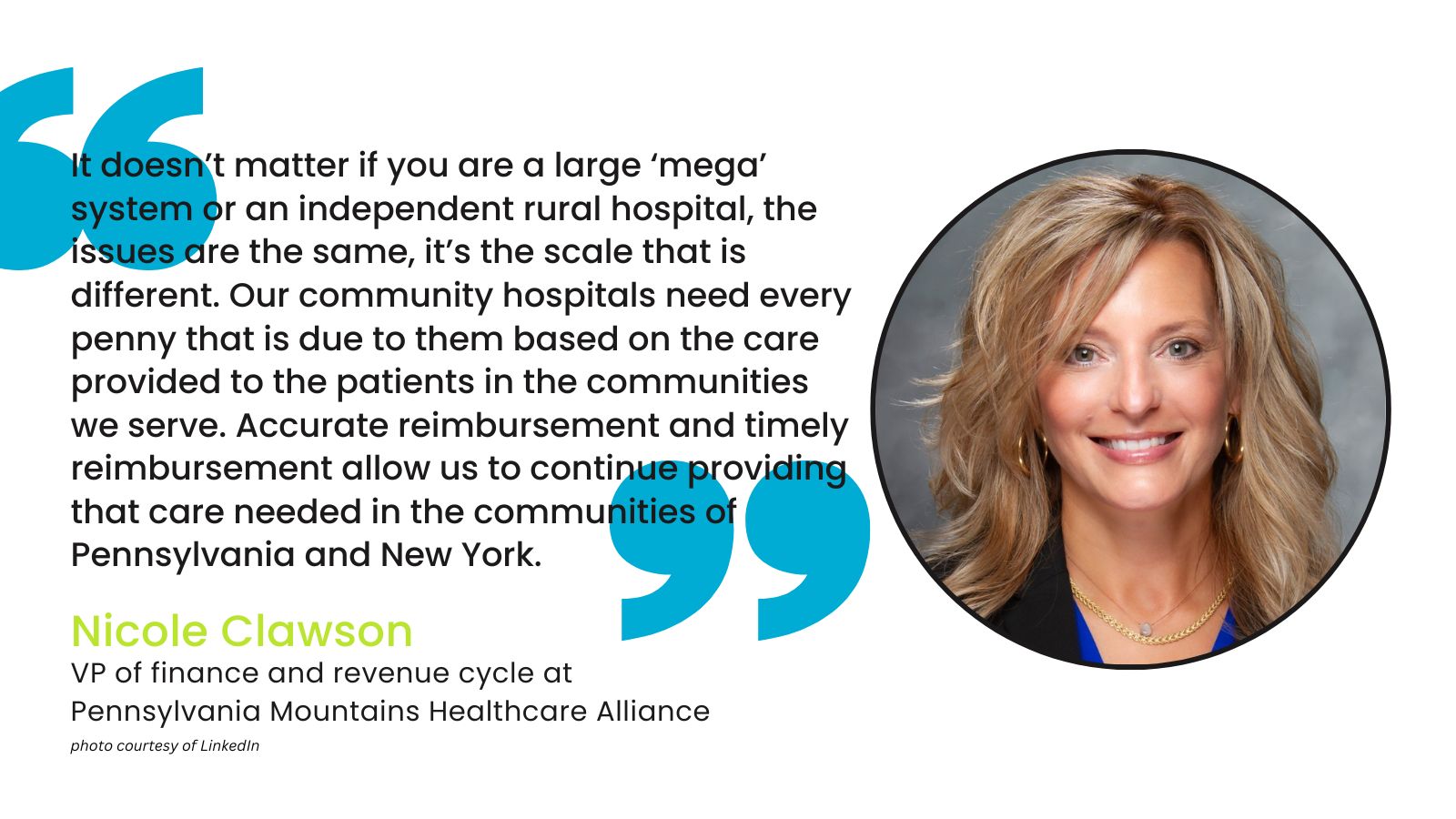
It doesn’t matter if you are a large ‘mega’ system or an independent rural hospital, the issues are the same, it’s the scale that is different. Our community hospitals need every penny that is due to them based on the care provided to the patients in the communities we serve. Accurate reimbursement and timely reimbursement allow us to continue providing that care needed in the communities of Pennsylvania and New York.
Grouping the products we utilize in revenue cycle systems and technology with this end-to-end solution was important for premier pricing. Using the leverage of the membership as a whole when contracting is also important and a standard process in the revenue cycle divisions of PMHA.
HealthLeaders: Why did you choose this particular platform for your organization? What made it such a good fit?
Clawson: It was chosen due to its ability to provide a true end to end solution. We not only needed what I would call the standard products: data quality, eligibility, denials management, collections, and billing workflow but our other division, contract management and payer relations, was being manually managed and in need of a system.
We were able to get all the products and modules we needed within the platform with all of the functionality and capabilities desired and incorporate it with those products we already had.
HealthLeaders: What is the process of implementing this new platform like? Who is involved with the decision making and why?
Clawson: For myself and our organization, it was inclusiveness. What I mean by that is its important to include our members at different levels within our year-long system strategy task force. A committee that included our core PMHA leadership team and various member hospital employees for those within the shared service management division and member hospitals in general. We had members of managers, directors, and CFOs of our hospitals all involved in the decision making.
We wanted a partner who again understood our model at PMHA, so we did a deep dive into vendor selection that included interviews with over 15 companies, those we considered through research to be the highest ranking in revenue cycle technology. We wanted a company that invested in technology and provided the efficiencies we needed and were looking for.
Overall, it was methodical, we were not going to rush into making a selection. We narrowed it down to three vendors and included all levels of the revenue cycle staff at our shared service hospitals to demo each of the products.
The Office of Inspector General (OIG) is eyeing improper payments, over payments, and denied claims.
Regulatory burdens are top of mind for revenue cycle leaders as they work to increase reimbursement and improve their bottom lines. The OIG has been keeping its eye on improper payments, over payments, denied claims, and more, so staying abreast of the OIG’s work is essential in making sure your revenue cycle runs smoothly.
Check out some of the recent findings you may have missed:
OIG Audit Uncovers $580M in Improper Medicare Payments for Psych Services
More than half of the $1 billion in temporary pandemic-related psychotherapy services paid by Medicare in the first year of the public health emergency were incorrectly billed, federal auditors say.
The OIG examined the CMS’ mental health services records for both in-person and telehealth visits from March 2020 through February 2021 at the start of the public health emergency.
The audit covered approximately $1 billion in Part B payments for more than 13.5 million psychotherapy services during the period. The audit picked two random samples of psychotherapy services: one of 111 enrollee days for telehealth services, and the other of 105 enrollee days for in-person services.
Medicare Paid Providers $128M in Duplicate Payments for VA Care
Medicare overpaid providers about $128 million over five years for medical care that the Veterans Administration (VA) had already paid for, federal watchdogs report.
The OIG determined that the "duplicate payments occurred because the Centers for Medicare & Medicaid Services did not implement controls to address duplicate payments for services provided to individuals with Medicare and VHA benefits."
OIG: Identifying Denied Claims in Medicare Advantage Needed to Combat Fraud
Requiring MA organizations (MAOs) to identify when payment claims are denied would improve oversight of fraud and abuse, according to the OIG.
The HHS watchdog conducted a study to examine whether the lack of an indicator to identify payment denials in MA encounter data makes it harder for proper oversight of MAOs.
OIG IDs $216M in Possible Medicare Drug Testing Overpayments; CMS Rejects Claw Back
Federal watchdogs are recommending that the CMS claw back as much as $216 million for noncompliant definitive drug testing paid to at-risk Medicare providers.
The audit found that 1,026 at-risk providers in the five-year period routinely billed for a definitive drug testing service with the highest reimbursement amount (procedure code G0483) more than 75% of the time, compared with 4,227 "other providers" who "did not routinely bill this service."
The CFO of DCH Health System talks investing in revenue cycle technology when budgets are tight.
Nina Dusang, CFO of DCH Health System, a Tuscaloosa, Alabama-based healthcare provider, recently chatted with HealthLeadersabout the future of the system, and one area Dusang wants to invest in is revenue cycle technology, but with one caveat: a tight budget.
"Financially, we are starting out from a negative position and trying to claw our way out so that we can make sure we serve our community. For us, it's about being stewards of our community's money. So, looking at the entire image is extraordinarily important when investing," Dusang said.
“We don't believe we can cut our way to prosperity when I say that at all. But we do believe rigorous good business practices and cost containment are of utmost importance, while we try to find pockets of profitable business,” Dusang said.
However, cost is something DCH will always have to place a heavy focus on.
Cost efficiency ranks high for Dusang because DCH is designated as a sole community hospital—meaning it is the caretaker for its community. DCH cares for not only Tuscaloosa County but for about 11 counties that surround it, and those counties are some of the poorest in Alabama, she says.
Because cost efficiency is so important, the system needs to get a lot of bang for its buck when it implements technology. "We really have to consider the pricing versus the efficiency we will gain," Dusang says.
"I think the two areas that have the most potential [for cost efficiency] are AI and bots. There could be huge gains in our revenue cycle by using that particular technology. I'm very excited about the potential of what we're going to be able to do there, but we have to do our due diligence as an organization and find the right partner," Dusang said.
Dusang says she has spoken with several revenue cycle bot companies, and it is very clear that they are new to implementing tech because the pricing is all over the board. "One company wanted to charge me a percent on improvement, and I would have ended up paying more than it would cost to hire 10 people to do the work—that’s not efficient."
"A lot of technology is overpriced for what you're gaining. And again, as CFO I have to see our bottom line improve so that we can sustain ourselves and be able to provide better access to care, more care for more people, kept here locally," Dusang said.
Cigna is taking heed at its "burdensome" documentation requirement.
Just days before it was to take effect, Cigna announced it would delay implementation of a strict new policy requiring submission of office notes with all claims including evaluation and management (E/M) codes 99212, 99213, 99214, and 99215 and modifier -25 when a minor procedure is billed.
At the time, Cigna announced it would deny payment for these E/M services reported with modifier -25 if records documenting a significant and separately identifiable service are not submitted with the claim, and medical groups were quick to respond.
For background, the revenue cycle coding staff report modifier -25 for E/M services on the same day of another service or procedure when it is performed by the same physician or provider.
The payer first unveiled the policy last summer, then postponed its activation after more than 100 medical associations said the policy would be too administratively burdensome and would negatively impact patient care.
The payer announced this year that it would go live with the policy on May 25. But on May 23, Cigna announced it would postpone the requirement, and did not supply a new implementation date. “Cigna will continue to review for future implementation,” the insurance company stated.
All this back and forth means that staying compliant with payers has been, and will continue to be, a burden on the revenue cycle workforce. With already strained staff it can be hard to find extra hands, and money, to keep up with payer requirements and policy changes.







_0abf4.jpg)