Moody's latest report details how some of the largest healthcare systems are faring in 2023.
Moody's Healthcare Quarterly: July 2023 report shows a mixed bag of financial performance for some of the largest for-profit health systems in the country.
Coming up short is Community Health Systems, the U.S.’ third-largest for-profit system. The system saw its EBITDA fall by 18.1 percent to $335 million in the first quarter as salaries and benefits as a share of revenue increased by 1.3 percentage points, the report said.
For the first quarter of 2023, the system’s net operating revenues totaled $3.108 billion, beating analysts’ estimates by just 1.3%. The net loss attributable to Community Health Systems stockholders was $(51) million, or $(0.40) per diluted share—missing expectations by 145%.
"Our first quarter results include solid growth metrics and other promising indicators that demonstrate core demand for healthcare services is returning and that we are making progress with our initiatives and investments to capture volume," Community Health Systems CEO Tim Hingtgen said at the time.
"Some other more challenging dynamics such as payer mix changes and increased medical specialist fees affected our earnings in the quarter despite our ability to favorably manage other controllable expenses," Hingtgen said.
According to the July 2023 Moody’s report, a significant portion of the systems’ business is in rural areas, potentially driving up costs to recruit and retain staff. An unfavorable payer mix in these areas may also be a contributing factor, as it’s CEO noted.
The other two largest for-profit systems are faring better this year, according to the Moody’s report.
Both HCA Healthcare and Tenet Healthcare saw improved EBITDA in the first quarter of 2023 as salary and benefit obligations were alleviated, the report said.
In contrast to Community Health, the report says HCA and Tenet hospitals provide care in predominantly urban areas and the payer mix is more favorable.
Price transparency adherence may become more complex in 2024.
CMS recently released the 2024 OPPS proposed rule, and among the yearly payment rate changes, CMS proposed changes to its price transparency regulations.
In the proposed rule, CMS is requesting that hospitals be required to submit a certificate verifying the accuracy and completeness of data and acknowledge any warning notices it may receive. CMS says it may also decide to post its assessment of hospital compliance and any compliance action taken against a hospital on its website, including notifications sent to hospital leadership, if the proposed rule is finalized.
Currently, hospitals are required to make some of the 300 standard charges shoppable services by placing them in a consumer-friendly format or offering a price estimator tool patients can use to estimate out-of-pocket costs, but in the proposed rule, CMS wants to require hospitals to display standard charges data within a specific template.
CMS also proposed hospitals encode all standard charge information, including but not limited to information such as each standard charge type and expected charges in dollar amounts for items or services currently denoted as a percentage or algorithm for payer negotiated prices.
This proposed rule comes on the heels of a separate crack down that CMS announced earlier this year.
In April, the agency announced it would require corrective action plan (CAP) completion deadlines, impose civil monetary penalties earlier and automatically, and streamline the compliance process of price transparency requirements.
CMS says it conducts over 200 comprehensive reviews of hospital price transparency compliance per month, and as of April 2023, CMS has issued more than 730 warning notices and 269 CAP requests. It has also imposed civil monetary penalties on four hospitals for noncompliance.
Although CMS maintained its requirement that noncompliant hospitals submit a CAP within 45 days from the CAP request, it will now require these hospitals to be in full compliance with price transparency guidelines within 90 days from when it issued the request.
CMS released its proposed payment update for outpatient services, but hospital groups are saying it's not enough to fight "persistent financial headwinds."
Hospitals may be seeing a 2.8% payment increase for outpatient services for calendar year 2024, according to CMS’ 2024 OPPS proposed rule, but hospital groups say it is not enough.
This increase would also include a proposed 3.0% market basket update, offset by a 0.2% cut for productivity. According to the rule, ambulatory surgical centers (ASC) would also see a 2.8% increase in payment rates next year under the proposed ASC rule that was released alongside the OPPS rule.
CMS also proposes to continue using the productivity-adjusted hospital market basket update to ASC payment system rates for another two years despite plans to shift away from the system as hospital procedures shift to ASC settings.
In a statement American Hospital Association (AHA) executive vice president Stacey Hughes shared the association’s displeasure with the payment update.
“The AHA is concerned that CMS is proposing an outpatient hospital payment update of only 2.8% in spite of persistent financial headwinds facing the hospital field. Most hospitals across the country continue to operate on negative or very thin margins that make providing care and investing in their workforce very challenging day to day,” Hughes said.
“Without a more robust payment update in the final rule, hospitals’ and health systems’ ability to continue caring for patients and providing essential services for their communities may be jeopardized,” Hughes said.
CMS also proposes multiple provisions that would improve access to behavioral health services, including implementation of a statutorily required Medicare benefit for intensive outpatient programs and a new payment code for remote group psychotherapy.
The agency also proposes to:
Change certain quality reporting programs
Delay the in-person visit requirement for remote outpatient mental health services until the end of 2024
Finalize regulations establishing the rural emergency hospital provider type
Update the Medicare payment rates for partial hospitalization program services
Update the Conditions of Participation for Community Mental Health Centers
CMS will accept comments on the proposed rule through September 11.
With rev cycle tech at the helm, AUMC created a 12-month strategy to increase point-of-service collections.
As hospitals and health systems battle to increase margins and improve efficiency to remain financially healthy, revenue cycle and finance leaders have been looking to shore up processes in the revenue cycle to increase their bottom lines.
Augusta University Medical Center (AUMC) is no exception. The health system realized it was missing opportunities by not prioritizing pre-service and point-of-service payments and lacked user-friendly automation, which led to a negative patient financial experience, collecting pennies on the dollar, and writing off bad debt.
AUMC includes a 478-bed adult hospital, a 154-bed Children’s Hospital of Georgia, the Georgia Cancer Center, and more than 80 outpatient clinics across Georgia and South Carolina, so streamlining these processes was essential to its financial health.
HealthLeaders recently chatted with Sherri Creech, AVP of patient access services at AUMC, on a 12-month strategy she implemented to save big, streamline front-end processes, and help ensure financial stability moving forward.
HealthLeaders: AUMC runs a huge operation, so what sort of gaps were you seeing that made you realize you needed to implement a change to its revenue cycle processes?
Sherri Creech: Patients are providers’ second largest payers, so collecting payment prior to or at the time of service is critical to the overall financial health of the organization and our ability to serve the community with quality care.
When I joined AUMC in 2021, I could see we were missing opportunities by not prioritizing payment discussions or collecting payment up front. We collected just pennies on the dollar, and sometimes nothing at all. Historical data showed that annual point-of-service collections should total $12 million, and we were sitting at around $3.6 million annually.
There were several factors that contributed to this deficit. The patient access department lacked the automated technology to generate accurate cost estimates for patients, and staff were not trained or held accountable on collecting payment up front. Once we identified the root cause of the issues and set the financial target, we developed a 12-month strategy to get there. It would take system-wide participation to reach our goal and would include a combination of technology, training, and accountability.
In June 2021, we added a price estimation tool from AccuReg to our existing patient access suite. With tools already in place to ensure registration data accuracy and perform real-time eligibility verification on patient benefits, we had the foundation for generating accurate cost estimates and improving the financial patient experience.
With new technology in place, we revamped new-hire trainings and retrained existing staff and supervisors on how to engage patients financially. Attempting to secure payment prior to or at the time of service was no longer just encouraged, it was part of the job and a service we provide to patients.
HealthLeaders: Budgets are tight, so did you receive support when deciding to implement new tech?
Creech: Our CFO was supportive of the strategy and understood that meeting our goal would require a combination of technology, people, and processes. Staff needed to be equipped with the tools to confidently engage patients in financial discussions. Our vendor provided training on the software and our internal team conducted trainings on process and procedures around payment collection.
HealthLeaders: Because of these tight budgets, organizations need to be strategic when investing in technology. Since cost efficiency is so important, how were you able to ensure a positive ROI when investing in this new tool?
Creech: By and large our process for collecting prior to and at the time of service was manual. In the absence of having a systematized way to go about it, staff relied on various inputs to compensate. As far as cost goes, it was an easy decision because automation has enabled us to do more with less.
HealthLeaders: Since your previous collection processes were entirely manual, I’m assuming adding in tech was worth it?
Creech: Yes. One year after launching the price estimation software and establishing new trainings and protocols for payment collection, we reached $9 million in point-of-service collections. While short of our original target of $12 million, that’s a 150% increase from where we started, and that’s a huge achievement. The team couldn’t believe it, how small changes every day, like collecting a copay, can add up over time.
Additionally, by alerting staff to registration errors for real-time resolution, the quality assurance tool saved AUMC $1.4 million in back-end rework.
Staff are much more confident in their roles because they now have the tools to help them succeed. Automating cost estimates saves time and frees staff to provide a more personalized patient experience. Our staff visit with every patient to help them understand their bill and discuss obligations for partial payment or payment in full.
Like any change, it took time. But patients appreciate the cost transparency because it gives them choice and control over their healthcare.
HealthLeaders: When looking back, what are your thoughts on the overall process?
Creech: It can be difficult to discuss the financial aspects of healthcare with your patients, but at the end of the day, it is our duty as providers to educate patients on what they owe. We help our staff understand that it’s not just about collecting, it’s about providing a service for your patients. An informed patient is a happy patient, and that begins with understanding their costs.
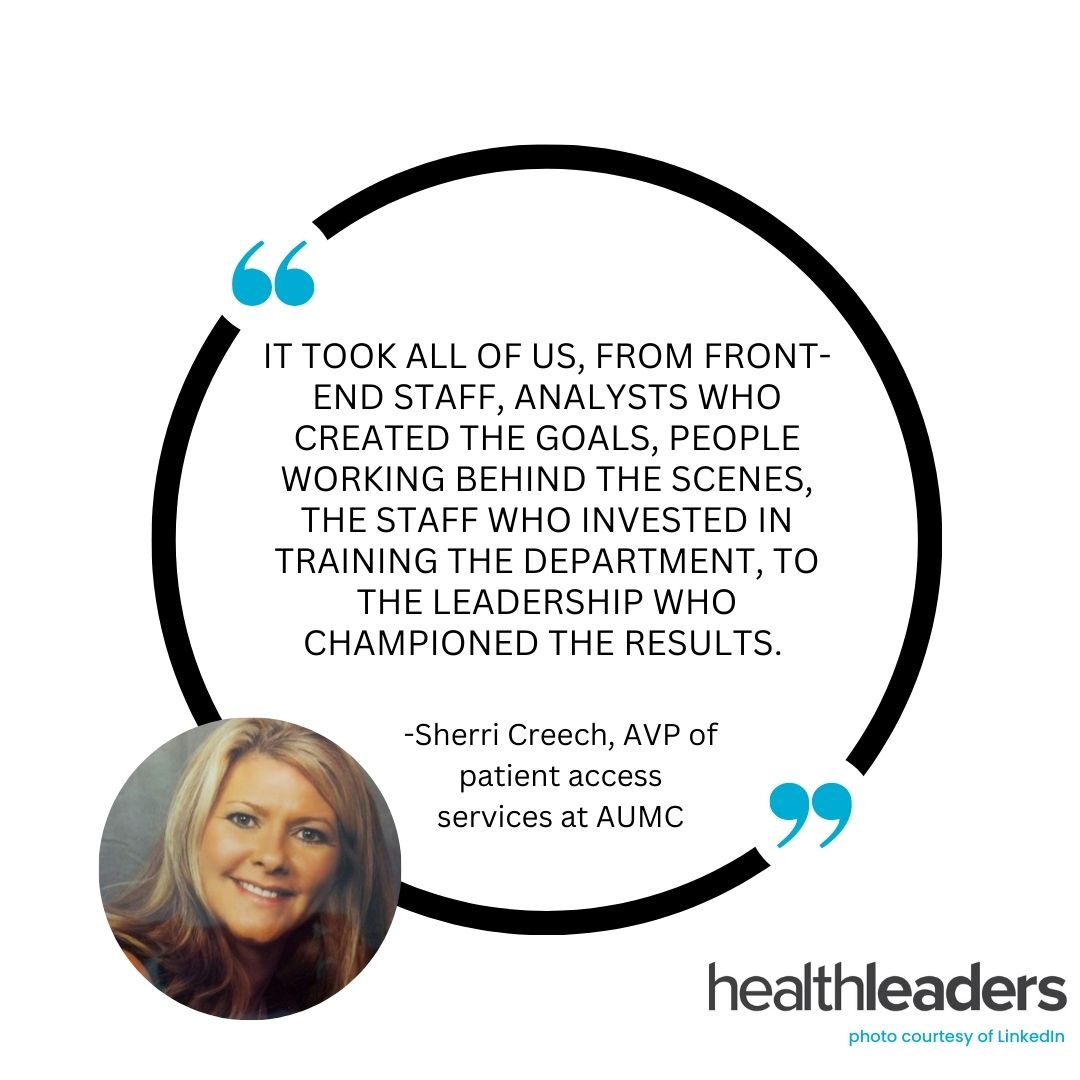
Improving the patient access experience was a system-wide goal for us and we were committed to changing how we approached payment. It took all of us, from front-end staff, analysts who created the goals, people working behind the scenes, the staff who invested in training the department, to the leadership who championed the results.
Reporting SDOH is a primary approach to achieving health equity, but a new study says it may be costing you.
As revenue cycle leaders place a heavier focus on social determinates of health (SDOH) code capture, a new study says hospitals with these more medically complex patients are more likely to receive a penalty under CMS’ value-based payment programs.
The study published in Health Affairs suggests that value-based payment programs do not adequately account for health equity factors when determining incentive payments.
The study analyzed value-based program penalty results for various groups of hospitals across three programs and assessed the impact of patient and community health equity risk factors on hospital penalties.
According to the study, there was a significant positive relationship between hospital penalties and several factors that affect hospital performance but that hospitals cannot control including medical complexity, uncompensated care, and the portion of patient populations who live alone.
As hospitals leaders know, addressing SDOH is a primary approach to achieving health equity, but the study found that patients that “live alone” had a strong association with hospital value-based penalties across all three of CMS’ programs. Other SDOH like poverty and unemployment “might or might not” be predictive of penalties though, the study says.
The study also found that hospitals with less complex patients were generally less likely to receive a penalty compared to hospitals with patients with the highest complexity. Hospitals with the highest relative portion of uncompensated care cost were somewhat more likely to receive penalties in two of the three CMS programs.
Hospitals have placed a larger focus on capturing circumstances in patients’ lives that can influence the quality of their life and overall wellbeing as SDOH will sometimes need to be reported on a claim form to support the medical necessity for specific services. The reporting of these codes is also tracked by government agencies, such as CMS for its value-based payment programs.
HHS is trying to establish a No Surprises Act data baseline.
The Department of Health and Human Services' (HHS) Office of the Assistant Secretary for Planning and Evaluation recently released the first annual report on the impact of the No Surprises Act.
Since it’s the first annual report, it merely identifies the factors the agency intends to evaluate for future reports, and gives an analysis of the state of these factors prior to implementation of the law for the purpose of creating a baseline for future reports.
According to the report, there was a downward trend in out-of-network claims prior to the No Surprises Act implementation. The prevalence of claims that were out-of-network decreased from 6.0 percent to 4.7 percent from 2012 to 2020. In addition, the share of total payments that were out-of-network declined over this period from 9.2 percent in 2012 to 6.8 percent in 2020, the report said.
The report also says that during that time, out-of-network billing was highly concentrated among a small percentage of physicians from certain specialties.
Numerous gaps remain in the understanding of the effects of state surprise billing laws, the report says. “Evaluations of state surprise billing laws have yielded varying results. Some of this variation likely stems from variation in how states determine out-of-network prices in surprise billing scenarios as well as other differences in state regulation, state health care markets, and other state level variation,” the report says.
In future reports, the agency intends to analyze various factors including:
The impact of market consolidation and concentration on prices, quality, and spending
The implementation and impacts of state surprise billing laws already in effect
Trends in market consolidation and concentration
Trends in out-of-network billing
HHS notes that the data necessary to evaluate the impact of the act on these market factors should become available in 2023 and will be used for the next report in January 2024.
On top of investment portfolio losses, incessant inflation, and staffing shortages, children’s hospitals have had to contend with a decline in patient acuity and a temporary increase in contract labor utilization, the report said.
How does this compare to previous years? Well, according to the report, 2023 children's hospital medians show operational deterioration and liquidity dilution with median cash flow metrics falling to the lowest level in a decade.
But, there is good news.
The report shows that children’s hospitals still have favorable reimbursement, unique market positions, and generally maintain a lower debt load, which allows for a more consistent performance, Fitch said.
The median days cash on hand for children's hospitals is 323, and while this is a significant drop to prior years, these numbers are still higher than overall acute care facilities and are still in line with pre-pandemic levels, the report said.
Despite these formidable challenges, the stand-alone children’s hospitals’ median rating remains strong at ‘AA-’ Fitch says.
“Children's hospitals continue to be able to drive positive operating results as a result of favorable reimbursement for higher acuity services and distinct market positions that provide for more consistent volumes compared to the overall acute care sector,” said Fitch Ratings director Richard Park in a news release.
Working through deteriorating margins isn’t new for Bridgett Feagin, CFO for Connecticut Children's—a level 1 pediatric trauma center with roughly $600 million in net patient revenue. She has been working tirelessly since joining the organization in June 2020 to balance the hospital's financial needs with its mission to help sick children.
“One thing I always tell my team is, no margin, no mission. You need a margin to continue with the mission. So, it's about balancing the needs of the community and being able to cover your costs,” she previously told HealthLeaders.
Connecticut Children’s doesn’t have high margins, she says, but it obviously needs a decent margin to be able to continue with patient care to cover inflation.
So, what’s the workaround?
“We work with our payers to cover our costs and a little bit more than our costs because we need to purchase capital and facilities. So, it's a fine line. We have to be good partners with our payers in order to get paid for the services that we render,” she said.
Payer scrutiny won't be letting up anytime soon, in fact, expect it to intensify.
The COVID-19 public health emergency has come to an end, which means more audits will be coming your way.
To prepare for a potential increase in payer audit activity, especially from CMS, it’s essential for revenue cycle leaders to examine upcoming trends so they can best protect an organizations’ bottom line.
In fact, organizations should expect heavier scrutiny from Medicare risk adjustment data validation (RADV) auditors in the near future, Rose Dunn, chief operating officer of First Class Solutions Inc. in Maryland Heights, Missouri, told NAHRI. “We are definitely going to see an uptick in activity because the RADV auditors have a few years to catch up on,” she said.
Telehealth will be looked at more intensely moving forward, Sandy Giangreco Brown, director of coding and revenue integrity at CliftonLarsonAllen LLP in Minneapolis, Minnesota, said in the same article. “I’ve done a fair number of audits for telehealth over the last three years and identified some things,” she says. Now that the public health emergency is over, leaders need to determine what will and won’t be allowed by different payers, she said.
To help with telehealth policy compliance and avoid potential payer audits, Brown suggests conducting internal audits as soon as possible. “I think we’re going to have to do our due diligence and make sure we are following who is allowing what,” she says.
Telehealth audits will likely focus on whether provider organizations were billing appropriately based on what rule was in place at that point in time, Dunn says. Auditors will look for documentation issues, as well as whether it was appropriate to treat a patient via telehealth. “I think this area is ripe for audits,” she says.
Going forward, Dunn emphasized to NAHRI that the need for national rules that preempt state requirements, especially for providers who are located near state borders.
Providers should also expect heavier scrutiny on reimbursement for COVID-19 claims, according to Brown. “We’ve seen some really sick patients who had COVID-19 on top of comorbidities,” she says. “And those are some long lengths of stay with very complex patients.”
Responding to COVID-19 audit requests shouldn’t be different than responding to any other audit requests based on diagnosis, such as sepsis or malnutrition, Brown noted to NAHRI. As long as the documentation is thorough and the audit response is complete and timely, there shouldn’t be any surprises.
Over the last few months CMS has been releasing procedure codes for your revenue cycle teams, both for inpatients and outpatients.
For your inpatient procedures, the updated ICD-10-PCS codes will available for discharges starting October 1. When it comes to outpatient reporting, most of the HCPCS code changes were just implemented July 1.
CMS recently announced the addition of 395 new diagnosis codes, 25 deletions to the diagnosis code set, and 13 revisions. An ample amount of these changes pertains to reporting certain diseases, accidents and injuries, and social determinants of health. These code updates will take effect on October 1.
MedPAC estimated that Medicare Advantage (MA) plans would be overpaid by $27 billion in 2023, mostly due to coding intensity of enrollee health conditions combined with bonus payments related to quality. That estimation did not factor in favorable selection of MA plans.
Detroit-based Henry Ford Health recently expanded its collaboration with CodaMetrix to include patient bedside visits, where abstraction takes an average of 40 minutes per patient and accounts for 20% of the health system's overall coding costs.
Medicare overpaid $22.5 million in 2019 and 2020 for physician services while enrollees were hospital inpatients or in skilled nursing facilities, according to an audit by OIG.
Researchers conducted analysis of the 2.1 million physician service claim lines identified at risk of overpayment because of non-compliance with the place-of-service policy.
Medicare pays for physician services separately from the payments it makes to inpatient facilities like skilled nursing facilities and hospitals. However, practitioners may not always correctly report the place-of-service code on a claim line, causing Medicare to pay more at higher nonfacility rates than at lower facility rates while beneficiaries were inpatients of facilities, OIG stated.
Multiple senators recently sent a letter to stakeholders to seek input on improving the 340B drug pricing program.
The senators, who are all members of a 340B bipartisan working group, released a request for information to look for policy solutions that would “ensure the program has stability and oversight to continue to achieve its original intention of serving eligible patients,” according to the letter.
The Health Resources and Services Administration administers the 340B program, and it previously issued guidance that allowed covered entities to dispense drugs through contracted pharmacies in the program. However, the senators noted that the current 340B statute does not clearly address this issue.
“The 340B drug pricing program is not working as effectively as it should,” said Senator Moran said in a press release. “The confusion around its contract pharmacy provision and lack of transparency and congressional oversight is failing the patients the program exists to help.”
In addition, a number of drug manufacturers haven’t offered 340B discounts on their covered outpatient drugs dispensed at contract pharmacies in recent years, according to the letter. The senators said that providers in their states have alerted them to the negative impact this has had on providers who serve their constituents, according to the letter.
The senators also acknowledged that stakeholders have been concerned by the need to strengthen the program’s integrity measures. To address these concerns, the senators are requesting information on ways to improve covered entities’ accountability and ensure transparency according to the letter.
As finance and revenue cycle leaders know, the 340B program requires drug manufacturers to provide outpatient drugs to eligible healthcare organizations and other covered entities at significantly reduced prices, and these payments are a lifeline for some orginizations.
"Henry Ford Health system and a lot of folks rely on 340B discounts and other mechanisms like disproportionate share payments. We're a big teaching institution, so a lot of these special payments that we do in order to teach the healthcare leaders of the future or make sure that we can take care of vulnerable patients are extremely important," Damschroder said.
"So that is an area that we and others are actively—in our advocacy—ensuring that these programs stay intact or evolve to a place that enhances the programs for the people that were trying to care for," said Damschroder.
Cheryl Sadro, the CFO for UC Davis Health, and Tammy Trovatten, the director of government reimbursement for UC Davis Health, also connected with HealthLeaders to discuss the financial issues hospitals and health systems have been dealing with over the course of the pandemic, one key area being 340B payments.
“One of the things we've been watching and will continue to watch through this process is where we go from here with 340B. We're the only level one trauma center in a multicounty area, and between 340B trauma and transplant, we've garnered a large portion of our bottom line,” Sadro said.
The senators’ goal is to ensure that the program has improved stability and integrity and that it continues to enable providers to use federal resources to provide better healthcare, the group says. Stakeholders should submit written responses no later than July 28, 2023.











4620.jpg)