This year won't be easy for CFOs, but there are a few ways to set an organization up for success.
Stimulus funds are gone, median revenue growth is still slow, and expenses are continuing to increase due to a reliance on expensive external contract labor and increased wage costs.
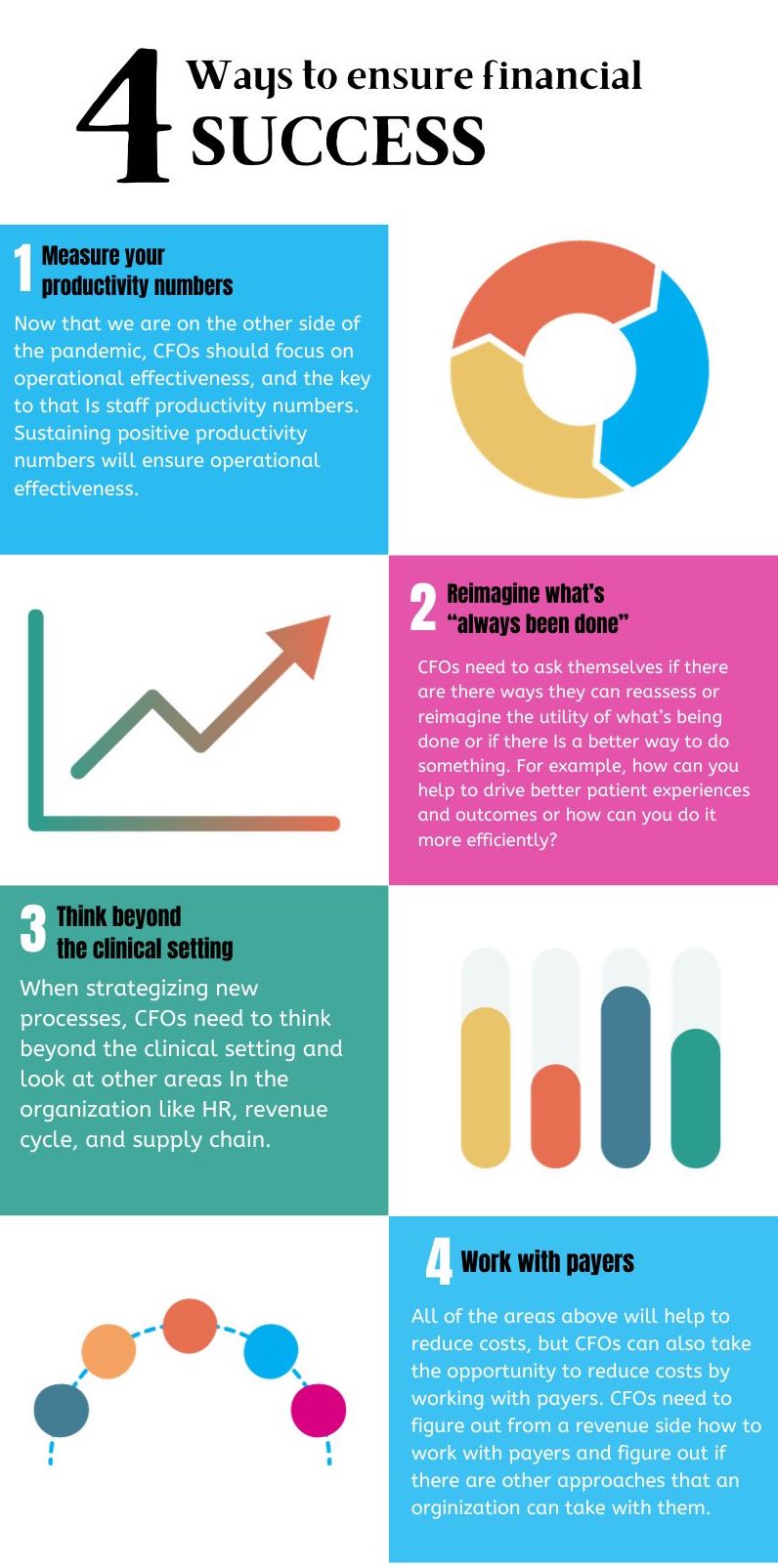
Luckily there are many ways hospital and health system CFOs can make sure they are setting their organization up for success, and Brett Tande, CFO of Scripps Health, recently shared four of them with HealthLeaders:
It’s clear that labor challenges—and the cost of that labor—will continue to be a prominent concern for healthcare organizations. As a handful of various industries have participated in massive strikes in 2023, the trend in healthcare is likely to continue.
That being said, hospital CEOs and CFOs should anticipate—and prepare—for some heightened labor negotiations this year.
The Kaiser union’s disagreement over across-the-board raises in 2023 was a significant financial concern, however, not uncommon. Hospital leaders must carefully assess the impact of wage increases on their budgets, especially when facing demands for higher pay. Balancing fair compensation for healthcare workers with financial sustainability is going to have to be top priority.
Bringing down labor costs is an area of focus for many hospital CFOs, but not at the risk of creating staffing turnover. Cost savings can be undercut by the resources required to replace workers, including interviewing candidates and training new employees.
New workers are also less productive in their initial transition period than established staff, which leads to less revenue. These factors should be considered when hospital leaders weigh the threat of losing workers by not meeting wage demands.
Wage laws
Even if your staff is happy, that doesn’t mean you won’t be required by law to increase wages across the board.
Take California for example.
California Governor Gavin Newsom signed a new law that will gradually raise healthcare workers' hourly minimum wage to $25, a bill that has an estimated price tag of $4 billion for the 2024-25 fiscal year.
But, that estimated $4 billion price tag is just at the state level and doesn't necessarily include the costs for private organizations or those in the non-profit healthcare world, so CFOs in California in particular really need to strategize for this unknown added cost.
As for CFOs outside of California, while wage increases weren’t as high as California, many states saw a wage increase on January 1.
What more can CFOs do?
Organizations need to recruit and retain talent in house and on a budget.
Gone are the days when CFOs of smaller (and even large) organizations can throw money at the problem—i.e., salary increases and bonuses—to attract and keep talent, especially when a hospital 20 minutes down the road can pay their staff much more for the same job.
So, what can leaders do to bolster the workforce while keeping expenses low? Placing an emphasis on culture and scheduling flexibility is a great place to start.
Here are several budget-friendly strategies that I have complied from talks with CFOs across the country that other leaders can employ in 2024:
Asses your employee benefits and perks: Offer a comprehensive benefits package that includes health insurance, retirement plans, and additional perks such as flexible work schedules, wellness programs, or tuition reimbursement.
Prioritize training and staff development: Provide budget-neutral ongoing training and professional development programs. Staff value opportunities to enhance their skills and advance their careers, so offering educational support, workshops, or mentorship programs can demonstrate your commitment to their growth. Cross-training employees in various roles within the organization is also a great way to enhance schedule flexibility and help bridge staffing gaps.
Form recognition or reward programs: Implement a robust recognition and rewards program to acknowledge and celebrate employee achievements. Non-monetary rewards, like public recognition, awards, or personalized thank-you notes, can boost morale and motivation.
Emphasize work-life balance: Promote work-life balance by offering flexible scheduling, remote work options (where feasible), and paid time off. Emphasizing the importance of a healthy work-life balance can help attract and retain staff.
Implementing wellness initiatives to support employee health and reduce burnout can also help in this area too. These programs can include stress reduction workshops, access to fitness facilities, and mental health support.
Create career advancement opportunities: Create a clear career path within the organization. Staff are more likely to stay when they see opportunities for advancement. Encourage internal promotions and provide training for leadership roles.
Streamline existing technology: Be creative in ways to bolster the technology and tools you already have to streamline workflows and reduce administrative burdens. This can improve staff efficiency and allow them to focus more on patient care.
Prioritize community involvement: The attendees agreed that many healthcare professionals—especially those in more rural areas—are motivated by a sense of purpose and making a difference in the community, so highlight your hospital's role within the community and engage employees in community service or outreach programs.
Incorporating a combination of these strategies can help small and medium-sized hospitals strengthen their workforce, improve staff satisfaction, and remain competitive in the healthcare industry without solely relying on salary increases.
In a field of 2,644 short-term, acute care non-federal US hospitals, Forbes says there were 100 organizations—which represent teaching and community hospitals of various sizes—that stood apart and serve as guides for the broader industry.
This list measured patient outcomes and experience, operational efficiency, financial health, and community impact, to see which organizations came out on top. And according to PINC AI’s analysis, there’s much to gain in following their lead.
“If all hospitals performed at the same level as the 100 Top Hospitals, more than 272,000 additional lives would be saved in the hospital and more than 432,000 additional patients would be spared complications as a result of care. $15.7 billion in inpatients costs would be avoided,” the report says.
While the entire list is available in the report, let’s take a look at the top 10 major teaching hospitals and large community hospitals:
Top Major Teaching Hospitals:
1. Baylor Scott & White Medical Center - Temple
Location: Temple, Texas Clinical outcomes:★★★★★ Operation efficiency: ★★★★★ Patient experience:★★★★ Financial health: ★★★★★ Community health survey performance: 100% Total number of years on 100 Top list: 13 Website
2. Trinity Health Ann Arbor Hospital
Location: Ypsilanti, Mich. Clinical outcomes: ★★★★★ Operation efficiency: ★★★★★ Patient experience: ★★★★★ Financial health: ★★★★ Community health survey performance: 100% Total number of years on 100 Top list: 13 Website
2. Baylor University Medical Center
Location: Dallas Clinical outcomes: ★★★★★ Operation efficiency: ★★★★ Patient experience: ★★★★★ Financial health: ★★★★★ Community health survey performance: 100% Total number of years on 100 Top list: 5 Website
4. St. Luke's University Hospital - Bethlehem
Location: Bethlehem, Penn. Clinical outcomes: ★★★★★ Operation efficiency: ★★★★★ Patient experience: ★★★★ Financial health: ★★★★★ Community health survey performance: 100% Total number of years on 100 Top list: 11 Website
5. University of Utah Hospital
Location: Salt Lake City Clinical outcomes: ★★★★★ Operation efficiency: ★★★★★ Patient experience: ★★★★★ Financial health: ★★★★ Community health survey performance: 100% Total number of years on 100 Top list: 6 Website
6. NYU Langone Health - Tisch Hospital
Location: New York City Clinical outcomes: ★★★★★ Operation efficiency: ★★ Patient experience: ★★★ Financial health: ★★★★ Community health survey performance: No survey data Total number of years on 100 Top list: 2 Website
7. Vanderbilt University Medical Center
Location: Nashville, Tenn. Clinical outcomes: ★★★★★ Operation efficiency: ★★★★★ Patient experience: ★★★★★ Financial health: ★★★ Community health survey performance: No survey data Total number of years on 100 Top list: 15 Website
8. Pennsylvania Hospital
Location: Philadelphia Clinical outcomes: ★★★★★ Operation efficiency: ★★★★★ Patient experience: ★★★★ Financial health: ★★ Community health survey performance: No survey data Total number of years on 100 Top list: 2 Website
9. UCHealth University of Colorado Hospital
Location: Aurora, Colo. Clinical outcomes: ★★★★★ Operation efficiency: ★★★★ Patient experience: ★★★★ Financial health: ★★★★★ Community health survey performance: 100% Total number of years on 100 Top list: 9 Website
10. Penn Presbyterian Medical Center
Location: Philadelphia Clinical outcomes: ★★★★★ Operation efficiency: ★★★★ Patient experience: ★★★★★ Financial health: ★★★★ Community health survey performance: 100% Total number of years on 100 Top list: 5 Website
Top Large Community Hospitals
1. St. David's Medical Center
Location: Austin, Texas Clinical outcomes: ★★★★★ Operation efficiency: ★★★★★ Patient experience: ★★★★★ Financial health: ★★★★★ Community health survey performance: 100% Total number of years on 100 Top list: 14 Website
2. St. David's North Austin Medical Center
Location: Austin, Texas Clinical outcomes: ★★★★★ Operation efficiency: ★★★★ Patient experience: ★★★★ Financial health: ★★★★★ Community health survey performance: No survey data Total number of years on 100 Top list: 5 Website
3. Parkridge Medical Center
Location: Chattanooga, Tenn. Clinical outcomes: ★★★★★ Operation efficiency: ★★★★★ Patient experience: ★★★★ Financial health: ★★★★★ Community health survey performance: 25% Total number of years on 100 Top list: 5 Website
4. Sharp Memorial Hospital
Location: San Diego Clinical outcomes: ★★★★★ Operation efficiency: ★★★★★ Patient experience: ★★★★★ Financial health: ★★★★★ Community health survey performance: 100% Total number of years on 100 Top list: 2 Website
5. Houston Methodist Sugar Land Hospital
Location: Sugar Land, Texas Clinical outcomes: ★★★★★ Operation efficiency: ★★ Patient experience: ★★★★★ Financial health: ★★★★★ Community health survey performance: No survey data Total number of years on 100 Top list: 5 Website
6. Cape Coral Hospital
Location: Cape Coral, Fla. Clinical outcomes: ★★★★★ Operation efficiency: ★★★★★ Patient experience: ★★★ Financial health: ★★★★★ Community health survey performance: 100% Total number of years on 100 Top list: 4 Website
7. Saint Mary's Regional Medical Center
Location: Reno Clinical outcomes: ★★★★★ Operation efficiency: ★★★★★ Patient experience: ★★ Financial health: ★★★ Community health survey performance: 100% Total number of years on 100 Top list: 4 Website
8. Medical City Plano
Location: Plano, Texas Clinical outcomes: ★★★★★ Operation efficiency: ★★ Patient experience: ★★★★ Financial health: ★★★★★ Community health survey performance: No survey data Total number of years on 100 Top list: 2 Website
9. Chippenham Hospital
Location: Richmond Clinical outcomes: ★★★★★ Operation efficiency: ★★★★ Patient experience: ★★★ Financial health: ★★★★★ Community health survey performance: 75% Total number of years on 100 Top list: 3 Website
10. Olathe Medical Center
Location: Olathe, Kan. Clinical outcomes: ★★★ Operation efficiency: ★★★★★ Patient experience: ★★★★ Financial health: ★★★★★ Community health survey performance: No survey data Total number of years on 100 Top list: 2 Website
Margin declines, expense growth, and an impending "labordemic" has been spelling trouble for non-profit hospitals looking to claw their way to financial relief.
Median operating and operating EBITDA margins for non-profit hospitals declined significantly from fiscal year 2021 to 2022, Fitch Ratings said, and this decline is primarily due to persistent high labor costs and the inelastic nature of hospital revenue.
In fact, with stimulus funds tapering off, median revenue growth slowed and expenses increased due to a reliance on expensive external contract labor and increased salary and wage costs.
So, what can CFOs of non-profit hospitals and health systems do to fight back?
CFOs need to place their focus on operational effectiveness, Brett Tande, CFO of Scripps Health, a $4.3 billion not-for-profit integrated health system in San Diego, California, told me in November.
“Consistent with what we've been showing in our quarterly results throughout 2023, we're probably going to lose about $30 [million] to $40 million in our next earnings report,” Tande says.
“One of the biggest items that we need to focus on is getting back to profitability,” he says.
Why has profitability been a challenge for Scripps? Aside from labor costs and hardships from the pandemic, the system has been undergoing various construction projects even prepandemic. But nonetheless, profitably is what pays for these updates.
“What pays for that is that positive operating cash flow that we need,” he says. “And when it's depressed, you've got to see those debt levels come up. And that's what we've been seeing over the last couple of years. And I think for in 2024, we'll see that more as well.”
That being said, getting that profitability back to a level that can support the organization will be very important, Tande said, “so, I will be working on that.”
The question then becomes, how do you do that?
Tande said the pandemic was very challenging for Scripps, not only financially but obviously for its staff as well.
Now that we are on the other side of the pandemic, Scripps’ focus is on operational effectiveness, and Tande says the last year or two have been really promising.
“Our productivity numbers now look great throughout the organization and we're really just trying to sustain that,” he says. “We think that has a lot of value.”
Aside from maintaining productivity, reimagining what’s “always been done” is necessary as well.
“Are there ways we can reassess or reimagine the utility of what we're doing or is there a better way to do something?” Tande pondered. “How can we help to drive a better patient experience and outcome or how can we do it a little bit more efficiently?”
That's the approach they have to take, he says.
“And again, it's not just in that clinical setting,” Tande says. “Reimagining operations has to be done throughout the organization. It could be in HR, revenue cycle, supply chain, or otherwise, but we need to try to be able to reduce our costs.”
When reducing costs, “there are a lot of irons that we have in the fire across the organization,” Tande says.
And, like most organizations, working with payers isn’t off the table when looking to reduce costs.
“We have to figure out from a revenue side how to work with payers and figure out if there are other approaches that we can take with them,” he says. “Which is something that the entire industry needs to do.”
Staying abreast of the healthcare finance market is a must for CFOs, and there were four stories that were top of mind for leaders.
Here are the four stories that CFOs tracked in 2023:
Mclaren St. Luke's closed down in 2023 due to 'historical financial losses'
McLaren St. Luke’s, a Maumee, Ohio-based healthcare provider, closed the hospital in the spring following years of declining revenues and an unstable reimbursement environment.
"Despite the tireless dedication of everyone associated with McLaren St. Luke’s, we have not been able to overcome the historic financial losses experienced by this hospital—losses that began long before COVID-19 that now run into the millions each month," Jennifer Montgomery, RN, MSA, FACHE, president and CEO of McLaren St. Luke’s, said in a statement announcing the closure. "Our passion for patient care and commitment to clinical excellence have never wavered. But sadly, we are not on a financially sustainable path."
Steward Health Care System CEO said we would see more VBC in 2023
Steward Health Care Systems prides itself on being a leader in the transition to value-based care (VBC). This Dallas-based operator of 39 hospitals across Arizona, Arkansas, Florida, Louisiana, Massachusetts, Ohio, Pennsylvania, Texas, and Utah generates roughly $6.5 billion in annual revenue and was founded on the VBC model.
CEO Ralph de la Torre, MD, connected with HealthLeaders this year to discuss the organization’s success with the VBC model, why hospitals may be reluctant to adopt a VBC model, and why he thought that would change in 2023.
How CFOs are balancing physician compensation with lowering labor costs
Hospital and health system CFOs are facing a bit of a dilemma when it comes to recruiting and retaining physicians. On one end, physician compensation is rising. On the other, slashing labor costs is a priority.
That reality necessitates that CFOs achieve a balancing act between employing top talent while keeping expenses in check. But hospitals' bottom lines aren't just affected by how much it costs to pay a physician. There are also opportunity costs and other expenses associated with physicians walking out the door in search of better compensation.
For that reason, cutting corners with physician salary isn't at the top of CFOs' to-do list. If anything, the opposite seems to be true, with hospitals acknowledging the competitive landscape for attracting and retaining physicians and showing willingness to invest in their workforce.
Deal Or No Deal: 3 ways CFOs can take a stand in contract negotiations with payers
If it seems like contract negotiations between payers and providers are becoming more adversarial and playing out in public more often, that's not just perception—it's the reality in which the fragmented healthcare system currently operates.
Thanks to economic headwinds made up of record inflation and operational challenges, hospital and health system CFOs find themselves with their backs against the wall in negotiations with insurers. Operating margins may be slowly improving, but they remain razor thin for many, especially in comparison to the profits payers continue to reap.
As contracts agreed upon in a different financial climate reach their expiration, the two sides are being forced to come to the table and find new common ground during a new normal in healthcare.
There are significant cultural and operational differences which will need to be accounted for when making moves in 2024.
CFOs will continue to fight against poor operating margins, reduced reimbursement, and inflated expenses in 2024, developing and executing a strategic path to a financially sustainable future is essential. For some, this can mean an acquisition or merger.
Hospitals and health systems of every type are feeling the financial pressure—even nonprofits will continue to grapple with existential questions about their strategy and structure moving forward.
Realizing the fundamental differences between for-profit and nonprofit hospitals will play a large part in a leader’s decision making.
For-profit and nonprofit hospitals are fundamentally similar organizations with subtly different cultural approaches to managing the economics of healthcare. All acute care hospitals serve patients, employ physicians and nurses as their primary personnel, and operate in the same regulatory framework for delivery of clinical services.
There are, however, a few primary differences between for-profit and nonprofit hospitals, which could potentially impact ROI.
TAX STATUS
The most obvious difference between nonprofit and for-profit hospitals is tax status, and it has a major impact financially on hospitals and the communities they serve.
Hospital payment of local and state taxes is a significant benefit for municipal and state governments, said Gary D. Willis, a former for-profit health system CFO said. The taxes that for-profit hospitals pay support "local schools, development of roads, recruitment of business and industry, and other needed services," he said.
The financial burden of paying taxes influences corporate culture—emphasizing cost consciousness and operational discipline. For example, for-profit hospitals generally have to be more cost-efficient because of the financial hurdles they have to clear.
OPERATIONAL DISCIPLINE
With positive financial performance among the primary goals of shareholders and the top executive leadership, operational discipline is one of the distinguishing characteristics of for-profit hospitals, said Neville Zar, the former senior vice president of revenue operations at Steward Health Care System, a for-profit that includes 3,500 physicians and 18 hospital campuses in four states.
When Zar was at the system, a revenue-cycle dashboard report was circulated at Steward every Monday morning at 7 a.m., including point-of-service cash collections, patient coverage eligibility for government programs such as Medicaid, and productivity metrics.
A high level of accountability fuels operational discipline at for-profits, Zar said.
FINANCIAL PRESSURE
Accountability for financial performance flows from the top of for-profit health systems and hospitals, said Dick Escue, former CIO at a health insurance company. Escue also worked for many years at a rehabilitation services organization that for-profit Kindred Healthcare of Louisville, Kentucky, acquired in 2011. "We were a publicly traded company. At a high level, quarterly, our CEO and CFO were going to New York to report to analysts. You never want to go there and disappoint. … You're not going to keep your job as the CEO or CFO of a publicly traded company if you produce results that disappoint."
Finance team members at for-profits must be willing to push themselves to meet performance goals, Zar said.
For-profit hospitals also routinely utilize monetary incentives in the compensation packages of the C-suite leadership, said Brian B. Sanderson, managing principal of healthcare services at Crowe.
"The compensation structures in the for-profits tend to be much more incentive-based than compensation at not-for-profits," he said. "Senior executive compensation is tied to similar elements as found in other for-profit environments, including stock price and margin on operations."
In contrast to offering generous incentives that reward robust financial performance, for-profits do not hesitate to cut costs in lean times, Escue says.
"The rigor around spending, whether it's capital spending, operating spending, or payroll, is more intense at for-profits. The things that got cut when I worked in the back office of a for-profit were overhead. There was constant pressure to reduce overhead," he says. "Contractors and consultants are let go, at least temporarily. Hiring is frozen, with budgeted openings going unfilled. Any other budgeted, but not committed, spending is frozen."
SCALE
The for-profit hospital sector is highly concentrated. In 2023, there are 5,157 community hospitals in the country, according to the American Hospital Association. Nongovernmental not-for-profit hospitals account for the largest number of facilities at 2,978. There are 1,235 for-profit hospitals, and 944 state and local government hospitals.
On the other hand, the country's for-profit hospital trade association, the Federation of American Hospitals, represents 1,000 tax-paying community hospitals and health systems throughout the U.S., accounting for nearly 20% of U.S. hospitals.
Scale generates several operational benefits at for-profit hospitals.
"Scale is critically important," said Julie Soekoro, former CFO of a Community Health Systems (CHS)-owned hospital. And one benefit of being CHS-owned? The access to resources and expertise, Soekoro said at the time.
Best practices are shared and standardized across all CHS hospitals. "Best practices can have a direct impact on value," Soekoro says. "The infrastructure is there. For-profits are well-positioned for the consolidated healthcare market of the future… You can add a lot of individual hospitals without having to add expertise at the corporate office."
The High Reliability and Safety program at CHS is an example of how standardizing best practices across the health system's hospitals has generated significant performance gains, she says.
Scale also plays a crucial role in one of the most significant advantages of for-profit hospitals relative to their nonprofit counterparts: access to capital.
Ready access to capital gives for-profits the ability to move faster than their nonprofit counterparts, Sanderson says. "They're finding that their access to capital is a linchpin for them. … When a for-profit has better access to capital, it can make decisions rapidly and make investments rapidly. Many not-for-profits don't have that luxury."
COMPETITIVE EDGE
There are valuable lessons for nonprofits to draw from the for-profit business model as the healthcare industry shifts from volume to value.
When healthcare providers negotiate managed care contracts, for-profits have a bargaining advantage over nonprofits, Doran says. "In managed care contracts, for profits look for leverage and nonprofits look for partnership opportunities. The appetite for aggressive negotiations is much more palatable among for-profits."
This article was adapted from previous coverage. Reread it here.
Editor's note: This story was updated on 12/29/2023.
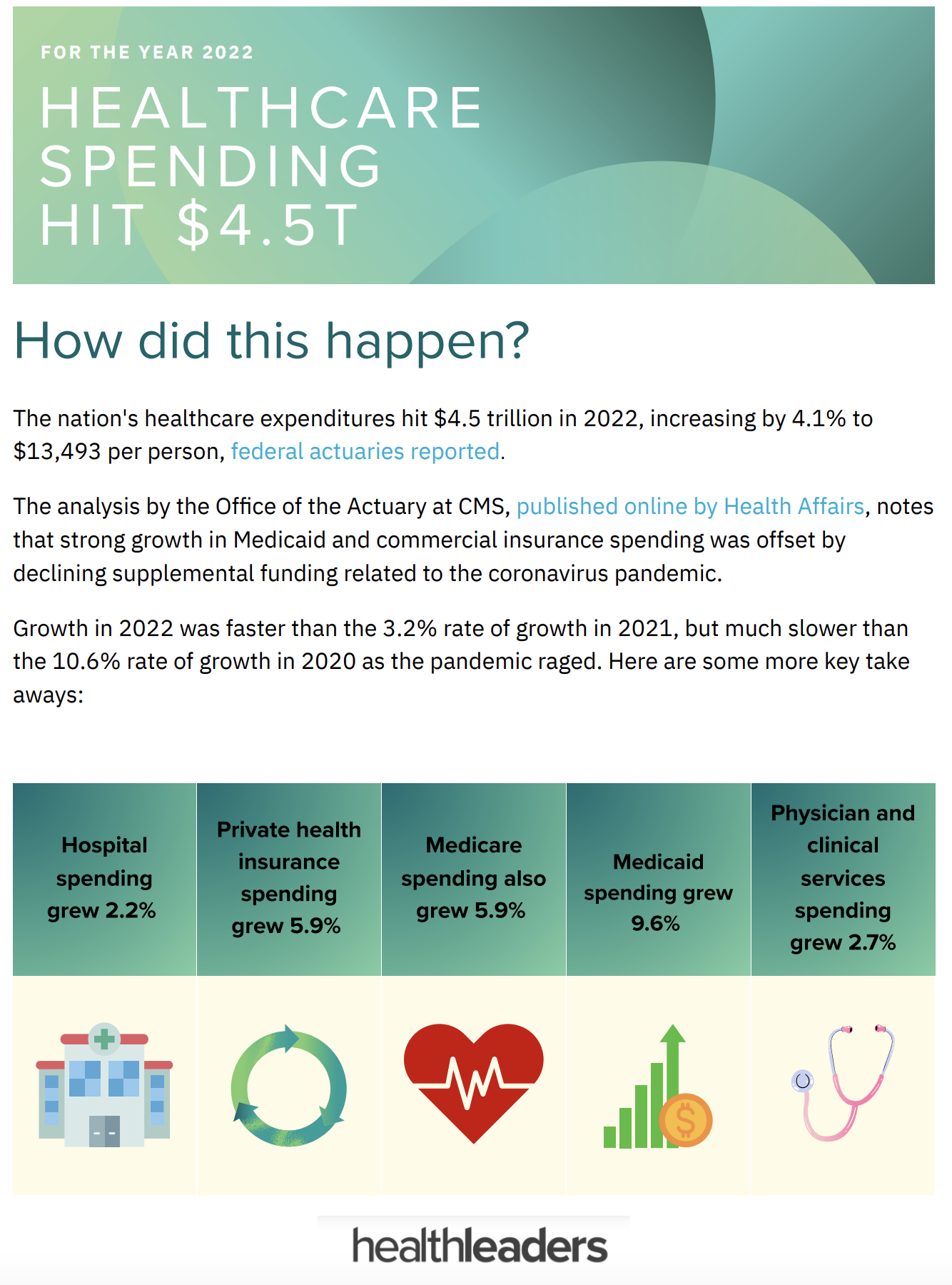
"The growth in healthcare spending in 2022 of 4.1% was more consistent with the pre-pandemic average annual growth rate of 4.4% over 2016-19," Micah Hartman, a statistician in the CMS Office of the Actuary and first author of the report, said in a media release.
"It remains to be seen how future healthcare spending trends will materialize, as trends are expected to be driven more by health-specific factors such as medical-specific price inflation, the utilization and intensity of medical care, and the demographic impacts associated with the continuing enrollment of the baby boomers in Medicare," Hartman said.
Below are a few more key takeaways from the report, and you can read John Commins full report here.
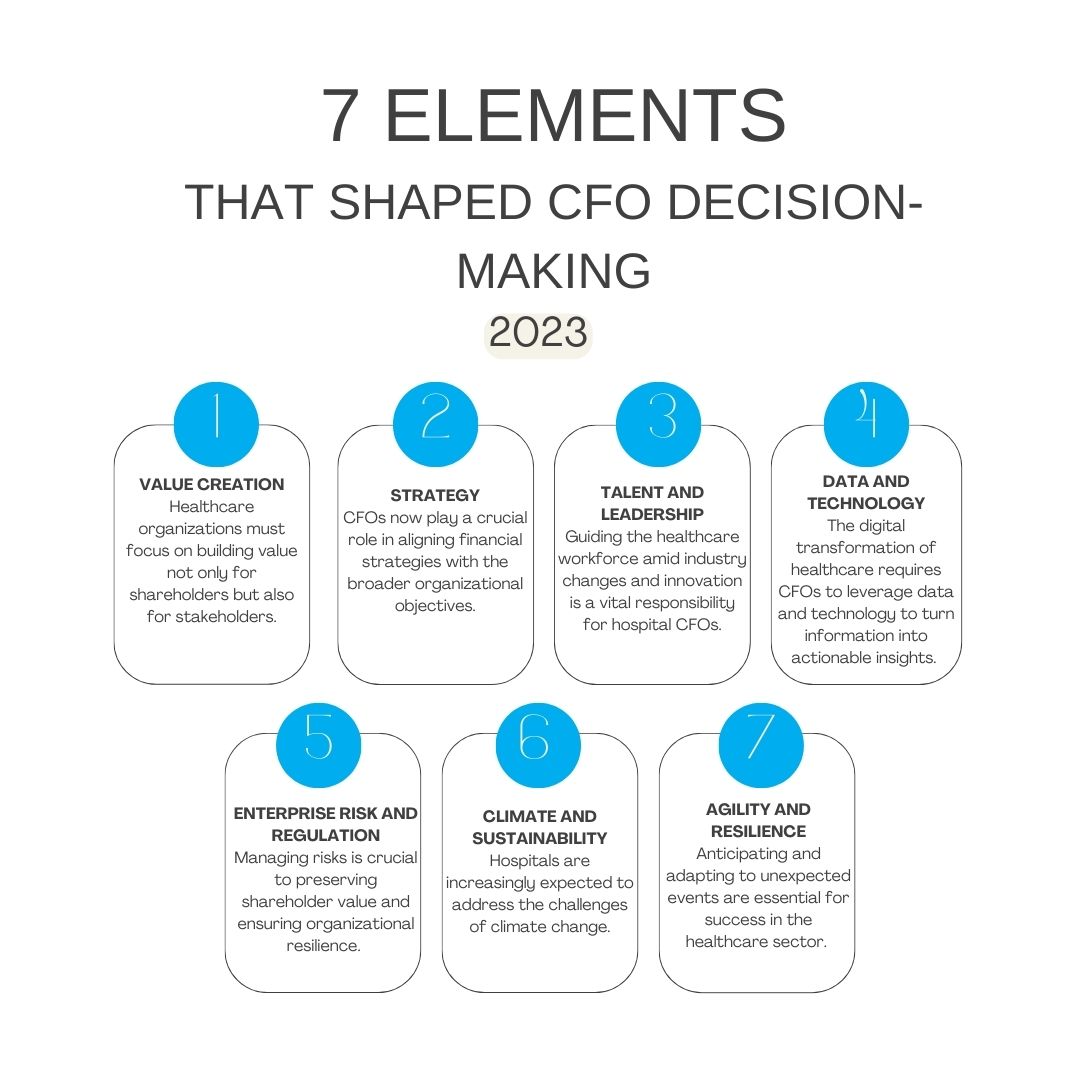
There were seven main threads propelling CFOs' decision making in 2023.
CFOs now find themselves at the intersection of various critical drivers that shape the financial outlook and strategic direction of their healthcare organizations.
So, what were the main threads propelling their decision making in 2023?
There were seven elements that encapsulated the key considerations for CFOs across all industries in 2023, according to Deloitte. Take a look at these seven drivers and read our full story to learn how each applied to CFOs in the healthcare sector.
A new bill may cause a shake-up for hospital and health systems.
The Lower Costs, More Transparency Act, a bipartisan healthcare policy bill, recently passed the House of Representatives, setting the stage for a potential shake-up for healthcare organizations.
This legislation aims to increase hospital price transparency and curb certain practices by pharmacy benefit managers (PBMs).
But why is it significant?
Well, of particular significance is the proposal to equalize payments for drugs in Medicare, whether or not they are administered in hospital outpatient departments or doctor's offices.
Additionally, the bill seeks to postpone payment cuts for hospitals catering to high volumes of uninsured patients until 2026, a delay from the previously anticipated 2023.
Healthcare organizations also need to be on the lookout for increased price transparency scrutiny, especially as many organizations are still struggling with adherence.
What does it mean for CFOs?
Crucial for hospital and health system CFOs is the potential impact of the bill's site-neutral policy on drug reimbursements in Medicare.
Hospitals' opposition to the equalization of drug payments, contending that it would cut into hospital revenue, underscores the financial implications for healthcare institutions
With the legislation projected to reduce hospital payments by over $3.7 billion over a decade, CFOs must carefully navigate the financial landscape amid evolving policies.
The bill also introduces transparency reforms for PBMs, addressing issues of spread pricing and mandating the disclosure of rebates and compensation. This legislative push aligns with broader efforts to scrutinize and regulate PBMs, acknowledging their role in influencing rising drug prices.
For CFOs, adapting strategies to comply with potential transparency requirements and understanding the financial implications of proposed changes will be pivotal.
New data says that health costs have not outpaced the rate of inflation this year, so what can CFOs do?
New data has been unveiled indicating that health costs have not outpaced the rate of inflation this year.
But what does this mean for hospital and health system CFOs? Read on to find out.
The report published by Turquoise Health utilized the list of CMS' 500 shoppable services. To understand the price dynamics of these shoppable services, the report dove into its payer dataset, which contained negotiated rates between payers and providers for all covered services across insurance plans and locations. Payers included UnitedHealthcare, Cigna, Aetna, and Blue Cross Blue Shield.
As of the third quarter's conclusion, there has been a 2% increase in negotiated rates for all 500 shoppable services, aligning closely with the 1.9% U.S. inflation measured by the PCE price index.
Notably, this growth rate remains below the overall U.S. inflation rate determined by the Consumer Price Index. The report highlights specific areas of notable price increases, such as Chickenpox and Measles vaccines, while identifying deflationary trends in services like off-hours medical services, allergy tests, and vaginal deliveries.
For example, in Los Angeles, the negotiated rate for vaginal delivery with post-delivery care varies widely, ranging from $1,183 to $32,563.
What does this mean?
It is crucial for hospital CFOs to recognize that substantial price variations exist for the same care both across different cities and within the same markets, as revealed by the report.
Understanding and addressing these variations is imperative for hospital CFOs to navigate evolving reimbursement landscapes and ensure financial stability.
As the healthcare industry undergoes increased scrutiny on pricing transparency, proactive strategies to manage and standardize costs will be pivotal for financial sustainability.
But where to start? Adoption of the price transparency requirement is key.
It will likely take some time before there is a widescale adoption of that type of pricing feature by providers, but hospitals shouldn't skip steps in the meantime by not doing their part to be as transparent as possible to patients.
"The higher percentage of completeness regarding the publication of machine-readable files and accurate patient estimate tools, the closer we are to empowering patients to gain confidence in knowing how much their healthcare services will cost," Chris Severn, CEO of Turquoise Health, told HealthLeaders.
"Adherence from both hospitals and payers also eliminates a significant burden of negotiating new rates because all rate data will be publicly available, meaning fair rate calculation becomes simpler and accessible," Severn says.
"Overall, these lead to lowering the cost of healthcare."




3474.jpg)