Hospitals are getting a much-needed hand to address cybersecurity concerns.
The Advanced Research Projects Agency for Health (ARPA-H) announced on Monday the launch of an initative to develop tools that IT teams can add to their cybersecurity efforts. As part of the Universal PatchinG and Remediation for Autonomous Defense (UPGRADE) program, the agency will be investing more than $50 million for the development of tools.
“It’s particularly challenging to model all the complexities of the software systems used in a given health care facility, and this limitation can leave hospitals and clinics uniquely open to ransomware attacks,” Andrew Carney, UPGRADE program manager, said in a statement.
“With UPGRADE, we want to reduce the effort it takes to secure hospital equipment and guarantee that devices are safe and functional so that health care providers can focus on patient care.”
The recent Change Healthcare ransomware attack and Ascension outage have highlighted the fact that the healthcare sector lags behind other sectors in cybersecurity. Such incidents have the capacity to halt the operation of an entire system, including claims submission, payment processing, and even clinical care, resulting in substantial losses for providers and health systems and potential harm to patients.
“A lot of companies may not have a plan, or an updated plan, or may not have communicated it and had it tested,” Joi Lee, manager of cyber governance, risk, and compliance for Moffitt Cancer Center previously told HealthLeaders.
“We’re in the business of treating patients, so a lot of the time, if you don’t have people that are focused on this type of stuff and know its importance, it gets thrown by the wayside. It’s not important until you need it.”
HealthLeaders recently held its virtual RevTech NOW Summit, bringing leaders from different organizations together to discuss the latest topics around revenue cycle technology.
Revenue and finance executives from CommonSpirit Health, Baptist Health, Frederick Health, Northwell Health, and University Health KC served as panelists through the day’s sessions.
Staff and RCM Solutions
During the first session, panelists discussed how they were able to get staff on board with the implementation of a revenue cycle management solution, emphasizing the importance of transparent and open communication.
“We really want to be able to thoroughly talk through the decision making, why we’re moving to [the] solution that we’ve selected,” Anissa Fabrizio, assistant vice president of HIM Coding and CDI for CommonSpirit Health, shared. “And we’re generally doing that once we’ve made the decision that we are truly moving forward.”
A common misconception when an organization tells staff its looking to bring a tech solution into revenue cycle operations is that staff are being replaced, which Fabrizio denied, explaining the technology is meant to help them be more efficient.
Preventing Disruption
As we’ve seen in recent months, every revenue cycle needs a back up or continuity plan in the event of operations being disrupted. During the second session, panelists shared some of their strategies to prevent disruption and ensure seamless workflows.
Vendor relationships play a crucial role here, as Sean McCardell noted, sharing that though Frederick Health was affected by the Change Healthcare ransomware attack, it was able to brings its claims platform back up within 72 hours.
“I understand that having a lot of vendors can be helpful when you run into issues like these,” he said.
“However, I think if you find the right vendors, you can work to overcome many of the obstacles, and as a smaller [health system], it’s a lot easier for us to manage a handful of vendors versus 15.”
Revenue Cycle Resilience
The last panel of the day focused on financial stability and how to develop a resilient revenue cycle through technology. Leaders must be more strategic as they navigate a new healthcare economy where patients are paying more of their healthcare costs and payers grow more stubborn with denials.
Andy Talford, senior director of back-end revenue cycle at Moffitt Cancer Center, explained the organization’s approach to combating denials.
“We’ve always taken the approach of ‘we don’t take a denial sitting down,’ so we pretty much try to find everything we can ourselves,” he said. “We don’t outsource all of our denials, but we do bring in third parties on certain types that they can do either because of volume or complexity.”
It will be some time before RCM solutions develop the capabilities to complete tasks like coding with accuracy.
As popular as revenue cycle technology solutions like bots and AI are, there are some tasks that require a certain level of expertise—a level that these solutions have yet to reach.
Denials and prior authorization are a consistent challenge for even the most efficient revenue cycles. With payers growing more and more stubborn with denial appeals, many organizations are looking for solutions capable of completing complex tasks involving coding and documentation.
HealthLeaders previously looked at the results of a study examining the accuracy of large language models (LLMs), state of the art artificial intelligence systems, when used for medical coding. The results showed that LLMs have not yet reached the point where organizations can utilize them for a task like coding. However, there are ways to leverage it alongside the efforts of revenue cycle staff.
Automated solutions are best utilized to complete repetitive, more administrative tasks, which enables staff to dedicate attention to more complex tasks. This can also present an opportunity to staff to upskill and expand their revenue cycle knowledge, such as becoming a certified medical coder.
Sherri Lewis, director of revenue cycle for Boulder Centre for Orthopedics, recently told HealthLeaders about how she’s able to get her staff on board with implementing rev tech into their processes.
“It’s [important] to show them the value [of the technology], get their buy in, and have them realize how it affects the whole practice,” she said.
Lewis is one executive looking forward to the ways AI and other rev tech solutions evolve over time, but believes that a human touch will always be needed.
“If I had an AI company [do our] coding, would they pull the right strings? Would they not transpose numbers?” she asked.
“Would they do it so great that we would all lose the ability to code after a while and just trust that they’re doing the right thing?”
As organizations add solutions to their processes, it's important that staff be onboard.
There are many things to consider when making the decision to invest in a revenue cycle management solution: the organization’s finances, what processes the solution will be applied to, and staff response. Getting revenue cycle staff to buy-in to the implementation of new technology can ensure a seamless rollout and increased productivity in the future.
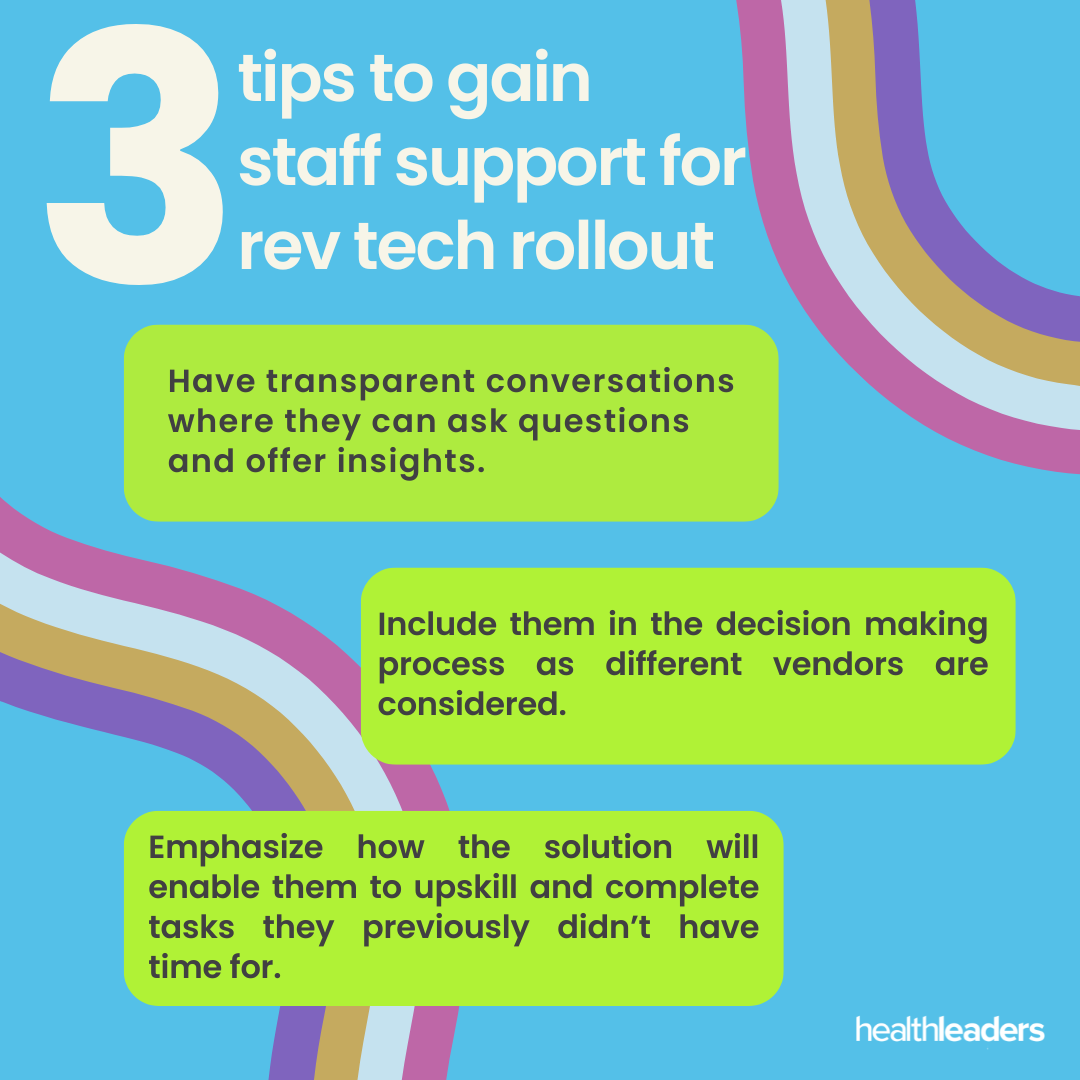
Here are three tips to gain staff support for a rev tech rollout.
Join us May 15 for our virtual, thought leadership panels specifically discussing the latest topics in revenue cycle technology.
Revenue cycle management solutions have made revenue cycle operations more efficient, streamlining workflows and completing repetitive administrative tasks, enabling staff to work on tasks they previously didn’t have time for.
As these solutions continue to evolve and develop more capabilities, leaders must be strategic when considering investment.
HealthLeaders RevTech NOW Summit, a virtual webinar event scheduled for May 15, will feature three panels, each focusing on a different aspect of investing in revenue cycle technology:
People First: Getting Staff to Buy into RCM Solution Implementation at 10:00 AM EST (Sponsored by Accuity) – Getting revenue cycle staff on board with the implementation of an RCM solution can be difficult. An announcement like this can cause some anxiety, with staff thinking their jobs may be displaced or simply feeling resistant to change. Panelists will discuss how the solutions their systems implement complement the work of their staff, as well as the importance of transparency before and throughout its rollout.
Strengthening Frameworks: Proactive Steps to Prevent Revenue Cycle Disruption at 11:10 AM EST (Sponsored by Waystar) – This panel will look at proactive measures organizations can take to prevent revenue cycle disruption and strategies to ensure seamless workflows. Panelists will share some of their strategies for successful revenue cycle operations.
Out of the Red: Revenue Cycle Resilience at 12:15 PM EST (Sponsored by Inovalon) – Our third panel will center on financial stability and developing a resilient revenue cycle. With patients covering more of their healthcare costs, along with payers standing firm on their denials, leaders need to be more strategic as they navigate the new healthcare economy. Panelists will discuss ways they maintain a steady revenue stream and the benefits of payment plans and accepting different payment methods.
We’ve got a strong line-up of revenue cycle executives from different health systems to share insights and strategies that have worked in their organizations. Our panelists represent CommonSpirit Health, Baptist Health, Frederick Health, Northwell Health, and University Health KC.
Here's what your organization should be doing to protect patient data.
When it comes to cybersecurity, healthcare is lagging behind other industries. The increasing frequency of cyberattacks has put numerous organization's on their guard and tightening up security is the best first step. Here are some tips to consider implementing.
A new survey's findings show that physician reimbursement has per patient decreased by 2.3% between 2005 and 2021.
The Medicare budget neutrality requirement is intended to balance the program’s expenditures against its budget as new services are added and volume increases. However, the findings of a new study by the Harvey L. Neiman Health Policy Institute show that hasn’t been the case.
Researchers examined the changes in payments for Part B services for 100% of traditional Medicare beneficiaries between 2005 and 2021.
Looking at the changes in payments for Part B services for all Medicare beneficiaries between 2005 and 2021, researchers found that physician reimbursement per patient decreased by 2.3% and patients saw a 45.5% increase in services.
Additional findings showed a 9.9% increase in payments per beneficiary across all medical providers and suppliers and a 206.5% increase in payments to non-physician practitioners. Payments to limited-license physicians increased by 16.3% and those to medical suppliers increased by 44.4%.
Low Medicare reimbursement rates continue to be a pain point for providers. In March, President Joe Biden signed a spending bill which cut the Physician Fee Schedule reimbursements rate down to 1.69%.
In a statement, Joshua Hirsch, MD, Neiman Institute affiliate senior research fellow, warned that the continued decline of Medicare reimbursement may negatively impact patients’ access to care.
“Continued decline of Medicare reimbursement relative to reimbursement by private insurance incentivizes providers to favor privately insured patients,” he said. “Our study pinpoints the extent to which real decreases in reimbursement are occurring despite greater consumption of care.”
Catherine “Mindy” Chua, DO, chief medical officer of Davis Health System, previously told HealthLeaders about how the cut will affect health systems and the physician practices they own.
“The physician fees are going to the hospitals to maintain the physicians they employ. We are not going to be decreasing what physicians are paid because Medicare is cutting our reimbursement,” she said. “You are not going to keep physicians if you do that.”
An overhaul of the facility's practice management system helped stabilize its finances.
Financial stability is a concern for many providers and it’s no different for central Alabama-based UAB Selma Family Medicine Center.
In 2022, staffing challenges and limited resources had the practice struggling to ensure quality of care and efficient operations, which began to negatively impact the financial state of the facility.
The medical center knew that their time should be spent focused on their patient population and not billing office tasks. To improve efficiency and streamline operations, the facility decided to implement new tech solutions into their processes, specifically for billing.
“I wasn’t really happy with how hard [staff] had to work to get the claims paid and money in the bank,” Jeff Denney, administrative director, told HealthLeaders. “It wasn’t always timely. I didn’t have good reports. It was hard to check in to see how [operations] were doing on the surface.”
Selma Family Medicine had always done its billing in-house but Denney saw the potential to improve efficiency with a new practice management system. While the implementation was successful, there was a learning curve to overcome as the facility’s previous system had been in place for about a decade.
“[At the time] everybody on the leadership side of the business office was very tenured and were reluctant to learn anything new, so that was a hurdle,” he said. For the most part, Denney added, staff weren’t apprehensive about bringing in a new system because they knew it would ultimately help them.
While demoing the new system, he was particularly impressed with having a team on the system’s side managing the reporting for coding, billing, and collections, and how much easier it made things for him and business office staff.
As part of the reporting support, the system has a feature that shows real-time updates, where staff can see where any holdups or missing items are and help move processes along.
“By outsourcing, you’ve got people who are working all day, every day, know the business in and out, and supporting you at a high level,” Denney said. “I feel like I know a lot more about the health of the practice, especially, as far as the claims, billing, and collections go.”
Not only did the new system solve an immediate problem, but it improved workflow efficiency. Staff now have time to complete other tasks in addition to their usual ones, and the practice’s billing, coding, collection, and reimbursement benchmarks have seen substantial improvement.
There has been a reduction in overall denials and day in accounts receivable, the latter by 78%. The gross collection rate has gone up 39%, as well as payments per encounter by 64%.
When it comes to revenue cycle management, AI must undergo more "evaluation and refinement" before it can be used for coding.
Artificial intelligence has become a popular solution in revenue cycle operations, but some tasks are best completed with a human touch.
A study from the Icahn School of Medicine at Mount Sinai has found that large language models, state of the art artificial intelligence systems, have limited accuracy when it comes to medical coding.
“Previous studies indicate that newer large language models struggle with numerical tasks,” Eyal Klang, MD, director of the D3M’s Generative AI Research Program, said in a statement. “However, the extent of their accuracy in assigning medical codes from clinical text had not been thoroughly investigated across different models.”
Researchers used over 27,000 unique diagnosis and procedure codes, excluding identifiable patient information, and asked LLMs from OpenAI, Google, and Meta to produce the most accurate medical codes. All three models showed limited accuracy in reproducing the initial medical codes.
“Our findings underscore the critical need for rigorous evaluation and refinement before deploying AI technologies in sensitive operational areas like medical coding,” Ali Soroush, MD, MS, assistant professor of data-driven and digital medicine at Icahn Mount Sinai, said in a statement.
The study’s findings will come as a disappointment to health systems struggling to hire medical coders and considering digital expansion to assist them.
After integrating AI into its bedside procedures in 2023 to assist with medical coding, Henry Ford Health was able to utilize staff in other areas that needed them.
“Regarding the big picture on the people side of Henry Ford Health, it reduces the daily workloads on physicians, medical coders, and billing administrators,” Joann Ferguson, vice president of revenue cycle at Henry Ford Health, previously told HealthLeaders. “Driving better financial and operational performance while improving our coders’ job satisfaction.”
Authors of the Icahn Mount Sinai study maintain that AI has potential but warn that there must be continuous development in order for it to be a reliable and efficient solution for the healthcare sector.








.jpg?itok=I8dSuPdI)
.jpg)